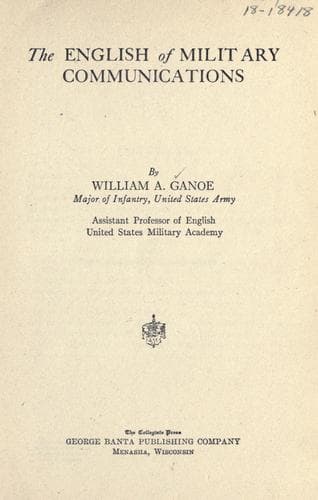
The English of military communicationsGanoe, William Addleman
History
The English of military communications
Ganoe, William Addleman
English language -- Rhetoric; Military orders; United States. Army -- Records and correspondence
LETTERS OF INSTRUCTION—Written under stress, but with more or less
leisure.
WAR DIARIES—Written under stress, but at any time, during
twenty-four hours.
REPORTS—Written during campaign or peace at comparative leisure.
GENERAL ORDERS }
SPECIAL ORDERS }
CIRCULARS } Written during campaign or peace
BULLETINS } concerning subjects of a routine
MEMORANDA } nature.
CORRESPONDENCE }
EXPLANATIONS }
LECTURES }
It is evident that we are going to have to write messages, field
orders, and operation orders when the enemy is upon us, and when
every second is vital. If we must stop in that crisis and putter
over the forms and methods of drafting our thoughts, how useless we
shall be! When that time comes, one thing alone should occupy our
conscious thought—our military idea. That will be sufficient to keep
busy the most brilliant intellect.
In order that we shall have, then, perfect freedom to grapple with
tactical, strategical, or logistical difficulties on the field of
battle, let us learn the forms and methods of messages, field orders,
and operation orders as soon as possible.
In so doing we shall discover two things,—
(1) That messages, field orders, and operation orders have a bearing
upon each other in the sequence given, and
(2) That the work of framing them will give us the greatest possible
practice in writing all other types of communication.
THE MESSAGE.—The general term _message_ may refer to (1) any informal
or short communication, (2) any directions or orders too abbreviated
to be known as field orders, or (3) any piece of information
transmitted in the presence of the enemy.
Number 1 is too broad for treatment here. Moreover, the ready skill
in composing anything of its nature should follow easily from what we
are about to practice.
Number 2 is to be considered in connection with field orders.
Number 3, then, is the important one for us to take up now. From its
definition it is already familiar to us as
THE FIELD MESSAGE
Since it deals entirely with the communication of information, it
might be well to inquire from what sources this information is to
be derived, in order that we may know something about the kind of
material with which we are going to deal. Just as a stenographer
acquaints herself with some of the workings of her employer’s
business in order to attain the greatest amount of usefulness, so we
should now look over the vast amount of territory which the contents
of field messages cover in order to gain the maximum efficiency in
composing these communications. Accordingly, we find that higher
commanders, adjoining troops, inhabitants of the country, newspapers,
letters, telegraph files, prisoners, deserters, spies, maps, and
reconnaissances, are all sources of valuable military information. It
is from these that we shall obtain our data.
Public-domain text, read in full here on John Shaqi.
Reviews
Reviews
No reviews yet
Be the first to share your thoughts on this work.
Join the Discussion
Join the discussion
Sign in to leave a comment or review.
Sign InorCreate an account