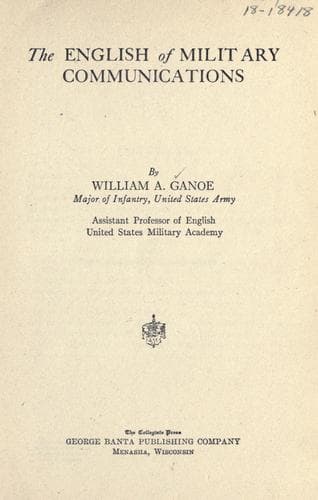
The English of military communicationsGanoe, William Addleman
History
The English of military communications
Ganoe, William Addleman
English language -- Rhetoric; Military orders; United States. Army -- Records and correspondence
FLETCHER,
SGT.
The outline of the whole message construction, then, would be as
follows:—
{ 1. Name of sending detachment.
{ 2. Location of sending detachment (place).
THE HEADING { 3. The Date.
{ 4. The Hour of Issue.
{ 5. The Number of the Message.
{ 1. Enemy.
{ 1. To whom sent. { 2. Your own troops.
THE BODY { 2. The body proper. { 3. Terrain.
{ 4. Your plan.
THE ENDING—THE SIGNATURE { 1. Surname.
{ 2. Rank.
The message we have composed, when assembled, would appear as follows:
Combat Patrol, 318th Infantry,
Cross Roads 500 yds. south of CLINTON SCHOOL HOUSE.
No. 3. 9 Jan. 18. 9-45 a. m.
To Commanding Officer Advance Guard, 71st Brigade:
Squadron of enemy’s Cavalry encamped in meadow 600 yards southeast
of here. Our officer’s patrol, which we met at ZION CHURCH at 8-10
a. m., reported two regiments enemy’s infantry intrenched at
railroad one mile south of here. Tail of our second battalion at
PARKSBURG steel bridge 7-20 a. m. Battalion was marching south.
MARTIN’S CREEK unfordable at any point between SMITH’S CORNERS and
GREENSBURG. Will move southeast from here along creek bed in order
to complete mission.
FLETCHER,
SGT.
(See sketch reverse side.)
Caution.—Remember that “your own troops” means friendly supporting
troops and not the troops of which you are in immediate command.
CHAPTER III
PROBLEMS IN THE COMPOSITION OF THE FIELD MESSAGE
“An intrinsically good tactical exercise,” says Griepenkerl,[2]
“loses by _faulty composition_ and careless or illegible
handwriting.... A rambling mode of expression, a long-winded,
elaborate style, is unmilitary. Therefore, test your order to see
whether you cannot cross out some superfluous word, or whether you
cannot think of some shorter and more suitable mode of expression;
_grudge every word_.”
But he goes on to say in another place that clearness takes
precedence over brevity; “therefore, rather use a long expression
where a shorter one might be misunderstood. _Brevity must never lead
to superficiality._”
Griepenkerl was speaking of orders. Yet our Field Service Regulations
state that “most of the rules adopted to secure clearness in orders
apply equally to messages.”
Public-domain text, read in full here on John Shaqi.
Reviews
Reviews
No reviews yet
Be the first to share your thoughts on this work.
Join the Discussion
Join the discussion
Sign in to leave a comment or review.
Sign InorCreate an account