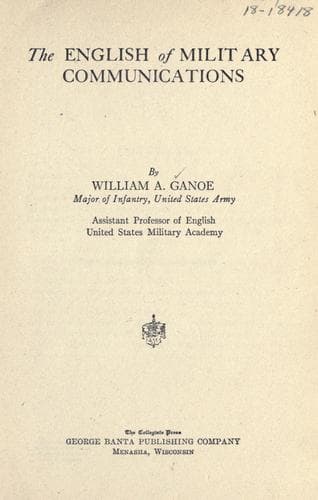
The English of military communicationsGanoe, William Addleman
History
The English of military communications
Ganoe, William Addleman
English language -- Rhetoric; Military orders; United States. Army -- Records and correspondence
1. On January 27, 1926, you are Corporal Peck in charge of a
reconnoitering patrol from the advance guard of the third battalion
of the 177th regiment of Infantry. You are proceeding along the
road east to Hunterstown from 549 (D, 5 and 6). You arrive at the
east edge of J. Bell’s orchard when you see several men at the zero
in 602. With the aid of your field glasses you make out four field
pieces and limbers to be turning to the north off the road just
opposite to, and south of, the men. The vehicles soon disappear
behind the knoll of 602. You can see that the men are wearing the
enemy’s uniform. After five minutes of observation, the men go out
of sight on the far side of the hill, and nothing further happens.
After you have written your message at half past four o’clock in the
afternoon, you travel under cover of the creek and fields in the
general direction of Henderson Meeting House, in the hope of finding
out more about the force in the vicinity of 602.
2. On August 27, 1920, you are Sergeant Fenton of a left flank
patrol sent out from the second battalion (27th Infantry) which is
marching north, as an advance guard to its regiment, toward 546 from
Hunterstown. As you come out into the open to the west of the J. Bell
farm house, you receive a volley from about twenty rifles from the
woods at the north. Two of your men are killed. With the remainder
of your men you retire hastily under cover of the Bell orchard to
the stream bed which you follow to the north until half way between
the Bell house and the “R” in Beaverdam. There you go through the
fields to the west until you get a glimpse of the high ground in the
vicinity of 574. You can make out through the corn-rows infantrymen
deployed and lying down facing you. They extend along the fence for
fifty yards on each side of the dirt road. You can see a field piece
half way between the ends of the fence and at the edge of the woods.
You go back to where you left the stream and write your message. You
hand it to one of your men at 20 minutes past two in the afternoon
for delivery. You then crawl forward leaving your men under cover in
the stream, and remain in observation in the corn-field.
Public-domain text, read in full here on John Shaqi.
Reviews
Reviews
No reviews yet
Be the first to share your thoughts on this work.
Join the Discussion
Join the discussion
Sign in to leave a comment or review.
Sign InorCreate an account