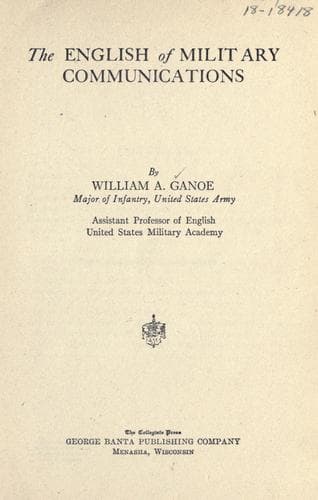
The English of military communicationsGanoe, William Addleman
History
The English of military communications
Ganoe, William Addleman
English language -- Rhetoric; Military orders; United States. Army -- Records and correspondence
7. On May 13, 1922, you are Major Gerald Pendelton of the 1st
Battalion, 43d Infantry. You have been ordered by your regimental
commander to establish by a line of your own troops a defensive
position facing east from the 4 (exclusive) in 664 east of Hamilton,
D-8, to the southeast corner of the orchard (inclusive), five hundred
yards northwest of Stock Farm. At five minutes to ten at night you
have formed your line as ordered and are beginning to entrench. You
are proceeding with your work when a messenger from B Company on the
left flank tells you that G Company of the 2d Battalion has arrived
at the 4 in 664, and that at ten minutes to ten the right flank
of that company was beginning to dig. Seven minutes later another
messenger from A Company arrives with similar information concerning
Company E, 2d Battalion, 47th Infantry; he states that the left flank
of that company at thirteen minutes to ten started to dig twenty
yards south of the corner of the orchard. You go over your lines
correcting positions here and there and start to send a message at
twenty-five minutes to eleven. The order of your interior companies
is, left to right, C, D.
CHAPTER V
VERBAL FIELD MESSAGE
OBSERVATION—ATTENTION—EXPOSITION
There are occasions when it becomes proper not to write the field
message, but to speak it. If the enemy is strong and active, so that
a bearer of information runs grave risk of capture, the message is
safer as a verbal one. In the case of the written one, both message
and messenger are lost; in the case of the verbal one, only the
messenger. Therefore, it is best to entrust the information to the
care of the messenger’s mind. The facts deposited there should remain
in readiness for the first opportunity of delivery.
There are times, too, when no chance is offered to write a message on
account of the pressure of the enemy. The attention of a leader may
be so occupied with warding off, or moving away from, strong hostile
bodies, that work with pencil and paper becomes an impossibility.
The form of the written field message must be abbreviated. The
gist of the _Heading_ and _Ending_ must be stated by the messenger
upon his arrival at his destination; and the _Body_ must be
contracted into one or two sentences depending upon the accuracy
and intelligence of the messenger. Where officers are messengers
the message may be lengthened. For our purpose and practice we must
attempt the shorter form.
The usual procedure in sending off a verbal message may be
represented by the following dialogue:
Patrol Leader (or Commander): “Swinton, go back at once to the
Commanding Officer of our Outpost and say,—
Twelve enemy’s cavalry marching north on Carlisle Road at Hamilton
11:45 a. m. Repeat.”
Swinton: “I am going back to the Commanding Officer of our Outpost
and say,—
Twelve of enemy marching north on Carlisle Road at 11:45 a. m.”
Public-domain text, read in full here on John Shaqi.
Reviews
Reviews
No reviews yet
Be the first to share your thoughts on this work.
Join the Discussion
Join the discussion
Sign in to leave a comment or review.
Sign InorCreate an account