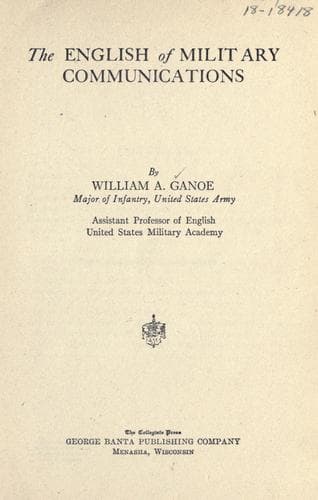
The English of military communicationsGanoe, William Addleman
History
The English of military communications
Ganoe, William Addleman
English language -- Rhetoric; Military orders; United States. Army -- Records and correspondence
Some will criticise the book in that the author is not conforming to
the principles which he is enunciating. They will say, “He tells us
to boil our communications to the clearest minimum while he himself
deals in reiteration and illumination.” Although this objection
appears just, it is nevertheless cursory. A closer view will reveal
the fact that the _purpose_ and _readers_ of communications are quite
different from the _purpose_ and _readers_ of a text book. One of
the first principles we learn in rhetoric is to suit our treatment
and diction to our _purpose_ and _readers_. Commanders await with
interest and expectancy the words of a field message or order.
Students await with skepticism or inertia the chapters of their
lessons. Although we rightly can prescribe the severest clearness
for something which is bound to be absorbed, we cannot be satisfied
with one precise, colorless statement of that which is likely to be
ignored. The student must be cudgeled and enticed. As a proof of
the correctness of this position, this course has been tried with
unexpected success upon the Cadets of the United States Military
Academy. The very items which have been repeated and highly colored
have proven themselves to the instructors to be the very ones which
have more easily driven the points home.
Grateful acknowledgment is made by the author to Lieut. Colonel L. H.
Holt, Professor of English and History, who made the book possible;
to Captain G. Hoisington, Infantry, for drawing a plate; to Captains
J. R. N. Weaver, Infantry, R. H. Lee, Coast Artillery Corps, L. E.
Moreton, Coast Artillery Corps, C. C. Benson, Cavalry, and J. H.
Grant, 24th Infantry, for their valuable criticism; and to Major A.
W. Chilton, Infantry, for the revision of the book in order to make
it conform to the practical work passed over—by his disinterested
correction the whole becomes more valuable as a text.
W. A. G.
CHAPTER I
OUR APPROACH TO A CRITICAL MATTER
All military language should be of the utmost brevity and clarity.
Death and disaster are the direct results of ambiguity. Throughout
all history mistaken directions and information have been the ruin
of whole campaigns. Careless wording, like careless shooting, is not
only ineffective but often suicidal.
The object of these few lessons is to give practice in putting the
language of military communication into form. It is hoped that by
means of certain technical and rhetorical principles the student may
gain proficiency in expressing his thoughts as he intends them and as
military efficiency demands them.
Public-domain text, read in full here on John Shaqi.
Reviews
Reviews
No reviews yet
Be the first to share your thoughts on this work.
Join the Discussion
Join the discussion
Sign in to leave a comment or review.
Sign InorCreate an account