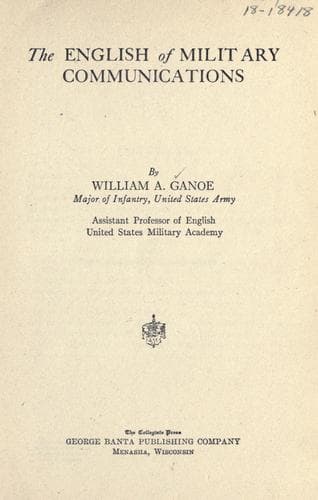
The English of military communicationsGanoe, William Addleman
History
The English of military communications
Ganoe, William Addleman
English language -- Rhetoric; Military orders; United States. Army -- Records and correspondence
Our Field Service Regulations state that “clear and decisive orders
are the logical result of definite and sure decisions.” But this
statement does _not_ imply that if a person arrives at a definite
and sure decision, he gains clear and decisive phraseology without
effort on his part. General Wagner, a pioneer among American military
authorities, divides into completely separate operations the act
of deciding upon a definite plan of action and that of drafting or
framing orders which will carry that decision into effect. One is
purely military and has to do with dispositions of forces; the other
is mainly rhetorical and has to do with manipulations of language.
Many a military man has decided certainly in his own mind what he
is going to do in order to carry out his mission, only to be faced
immediately with a harder task. He must set that definite idea in
the mind of some one else. “How,” he sighs, “shall I put this so as
to let my Captains, Smith and Jones, know exactly what I want?” He
seats himself on a warm rock under the blazing sun and chews his
pencil. What he at first writes down, he finds, is full of loop-holes
and is not expressive of what he means. He tries again, crosses out
words here and there, adds others, and changes his sentences until
the whole is undecipherable. In disgust he tears up the paper and
tries again. After fifteen minutes of such effort he holds in his
hand a few paragraphs of which he is not proud, but which will have
to do. There has been no want, perhaps, of clear tactical reasoning
on his part, but rather a distinct lack of ability to drive common
English home. His case, we find, is not exceptional. One has only to
listen to the discussions of military beginners (or of some, alas,
who are not military beginners) to hear this statement confirmed. How
often after having given careful or even brilliant estimates of a
situation will a man burst out with, “I know what I mean right here,
but don’t quite know how to say it!” All the way along there has been
a decided blank space between decision in the mind and embodiment in
language.
Public-domain text, read in full here on John Shaqi.
Reviews
Reviews
No reviews yet
Be the first to share your thoughts on this work.
Join the Discussion
Join the discussion
Sign in to leave a comment or review.
Sign InorCreate an account