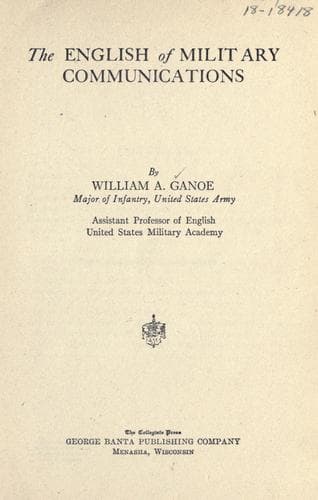
The English of military communications — John Shaqi
The English of military communicationsGanoe, William Addleman
History
The English of military communications
Ganoe, William Addleman
English language -- Rhetoric; Military orders; United States. Army -- Records and correspondence
Let us suppose that the observation and attention have taken in all
that they should. These various items lying in a more or less jumbled
mass must now be sorted. Information of one class must not be found
mixed with that of another class. Each organized body of information
must approach the leader’s judgment by itself so that: (1) nothing
will be overlooked; so that (2) each item will be with its proper
set. After they have all passed through his thought, certain ones,
of course, may be discarded; but they all must none the less be
first reviewed consciously by the leader. This process is called the
_estimate of the situation_. In order, therefore, to comply with
the full conditions of such an estimate, a fixed classification of
all the essentials which should go through the hopper of a leader’s
judgment has been made. After his information has been obtained and
before his decision has been formed, the leader must say to himself:—
1. What is my mission?
2. What are the forces—the enemy’s and my own?
3. What conditions are favorable and what unfavorable?
4. What is the enemy doing and what will he probably do?
5. What effect has the terrain upon my mission?
6. What different courses are open to me in order to carry out my
mission, and what are the advantages and disadvantages of each?
The method just described is no more than that of collecting,
classifying, and weighing data. It is the very process we must
follow before we can write a decent theme, article, report, or
anything fit to read. An estimate of a situation is nothing more
than an outline of observations made in order to arrive at a proper
conclusion. The leader has no time to write down the points. But he
nevertheless assembles in his own mind everything which bears on his
subject—unity; he classifies all this into groups with a certain
orderly arrangement—coherence; and he considers the effect of each
item upon his mission and situation—clear thinking.
THE DECISION
As soon as he has finished with this estimate of the situation, there
should stand forth as a result of this clear thinking his decision.
If he has been in the habit of making his ideas unmistakable in
conversation or writing—if he has been accustomed to dealing in good
exposition, his plan ought to be clear and simple. For no man can
make clear statements without first thinking clear thoughts. If then
he has habitually insisted upon his own use of only the clearest
phraseology, he ought certainly to arrive at a clear plan whatever
may be its tactical value.
THE EXPRESSION
Public-domain text, read in full here on John Shaqi.
Reviews
Reviews
No reviews yet
Be the first to share your thoughts on this work.
Join the Discussion
Join the discussion
Sign in to leave a comment or review.
Sign InorCreate an account