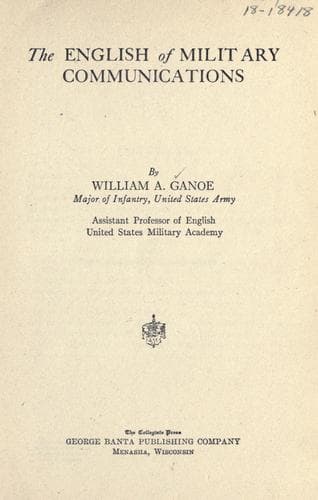
The English of military communicationsGanoe, William Addleman
History
The English of military communications
Ganoe, William Addleman
English language -- Rhetoric; Military orders; United States. Army -- Records and correspondence
The first has to do with the kind of situation that faced the man
who knew what he “wanted to say but couldn’t express himself.” Some
authorities argue that there is no difference between clear thinking
and clear expression. They give no place to the “mute inglorious
Milton.” They would not concede that the man groping for language
had formed a definite plan in his mind, because that plan was not
definite enough to be expressed. “If he has not thought in language,”
they say, “he has not really thought.” Their opponents claim that a
man thinks in pictures, and that he conceives his ideas as a painter
imagines objects. In his mind are the outlines and colors of what
he considers. There is truth in both views of the matter. But it is
likely from what we know of the training of the military man that his
mind works more by visualizing the troops and by conjuring up the
scene than by gaining his conceptions through words. His forces are
moving along roads, occupying trenches, or surging into conflict.
His map is not a plane surface with names upon it, but a vision of
highways, waving corps, and rolling hills. He is looking at these
things without mentally describing them. For the purpose of this
course, we shall take the view that there are occasions where we
deduce certain results, but are unable, because of unfamiliarity
with framing good sentences or because of a small vocabulary, to
communicate those results or deductions in accordance with common
usage.
The second road can be illustrated by comparison with the first.
There is a wide difference, although at first there does not
appear to be, between merely stating a thing clearly and making
it unmistakable. The first is but a negative approach to complete
certainty of expression, but the second must be a positive one. The
distinction is one more or less of attitude of mind, and although
heretofore it has been overlooked as an entity in English text
books and military regulations, it assuredly illustrates itself in
two types of men who actually exist. The man who is content with
merely making himself clear takes the attitude of, “O, well, they
will get what I meant because any other interpretation is absurd
or incorrect.” The man who is not content unless he makes himself
unmistakable says, “I won’t let any of them have the slightest
excuse for any other interpretation; when I get through there will
be but _one_ interpretation and that will be _mine_.” The first one
in sending a message to his commanding officer locates himself by
putting in his heading, “Irrigation ditch 500 yards east of southeast
corner of Catholic Church.” He notices another irrigation ditch fifty
yards further to the east, but says to himself, “If my commanding
officer measures the distance on the map he will know which one I
mean.” The second man, upon looking about him and discovering the
other ditch, does not accept the chance of letting his commanding
officer confuse the two ditches by a possible difference of maps
Public-domain text, read in full here on John Shaqi.
Reviews
Reviews
No reviews yet
Be the first to share your thoughts on this work.
Join the Discussion
Join the discussion
Sign in to leave a comment or review.
Sign InorCreate an account