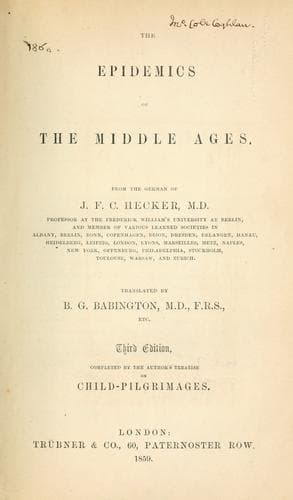
The Epidemics of the Middle AgesHecker, J. F. C. (Justus Friedrich Carl)
History
The Epidemics of the Middle Ages
Hecker, J. F. C. (Justus Friedrich Carl)
Black Death; Epidemics -- History; Hysteria, Epidemic
The dancing mania of the year 1374 was, in fact, no new disease, but
a phenomenon well known in the middle ages, of which many wondrous
stories were traditionally current among the people. In the year 1237,
upwards of a hundred children were said to have been suddenly seized
with this disease at Erfurt, and to have proceeded dancing and jumping
along the road to Arnstadt. When they arrived at that place they
fell exhausted to the ground, and, according to an account of an old
chronicle, many of them, after they were taken home by their parents,
died, and the rest remained affected, to the end of their lives, with
a permanent tremor[227]. Another occurrence was related to have taken
place on the Mosel bridge at Utrecht, on the 17th day of June, A.D.
1278, when two hundred fanatics began to dance, and would not desist
until a priest passed who was carrying the Host to a person that was
sick, upon which, as if in punishment of their crime, the bridge gave
way, and they were all drowned[228]. A similar event also occurred
so early as the year 1027, near the convent church of Kolbig, not
far from Bernburg. According to an oft repeated tradition, eighteen
peasants, some of whose names are still preserved, are said to have
disturbed divine service on Christmas eve, by dancing and brawling
in the churchyard, whereupon the priest, Ruprecht, inflicted a curse
upon them, that they should dance and scream for a whole year without
ceasing. This curse is stated to have been completely fulfilled, so
that the unfortunate sufferers at length sank knee deep into the
earth, and remained the whole time without nourishment, until they
were finally released by the intercession of two pious bishops. It is
said, that upon this, they fell into a deep sleep, which lasted three
days, and that four of them died: the rest continuing to suffer all
their lives from a trembling of their limbs[229]. It is not worth while
to separate what may have been true, and what the addition of crafty
priests, in this strangely distorted story. It is sufficient that it
was believed, and related with astonishment and horror throughout
the middle ages; so that when there was any exciting cause for this
delirious raving, and wild rage for dancing, it failed not to produce
its effects upon men whose thoughts were given up to a belief in
wonders and apparitions.
Public-domain text, read in full here on John Shaqi.
Reviews
Reviews
No reviews yet
Be the first to share your thoughts on this work.
Elsewhere in the archive
Join the Discussion
Join the discussion
Sign in to leave a comment or review.
Sign InorCreate an account