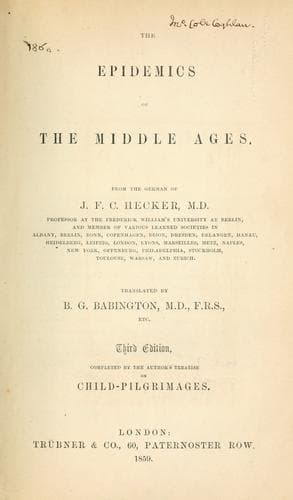
The Epidemics of the Middle AgesHecker, J. F. C. (Justus Friedrich Carl)
History
The Epidemics of the Middle Ages
Hecker, J. F. C. (Justus Friedrich Carl)
Black Death; Epidemics -- History; Hysteria, Epidemic
It is not out of place to remark here, that about the same time that
Tarantism attained its greatest height in Italy, the bite of venomous
spiders was more feared in distant parts of Asia likewise, than it
had ever been within the memory of man. There was this difference,
however, that the symptoms supervening on the occurrence of this
accident were not accompanied by the Apulian nervous disorder, which,
as has been shown in the foregoing pages, had its origin rather in the
melancholic temperament of the inhabitants of the south of Italy, than
in the nature of the tarantula poison itself. This poison is therefore
doubtless to be considered only as a remote cause of the complaint,
which, but for that temperament, would be inadequate to its production.
The Persians employed a very rough means of counteracting the bad
consequences of a poison of this sort. They drenched the wounded person
with milk, and then, by violent rotatory motion in a suspended box,
compelled him to vomit[309].
SECT. 6.—DECREASE.
The Dancing Mania, arising from the tarantula bite, continued, with all
those additions of self-deception, and of the dissimulation which is
such a constant attendant on nervous disorders of this kind, through
the whole course of the seventeenth century. It was indeed gradually
on the decline, but up to the termination of this period, showed such
extraordinary symptoms, that Baglivi, one of the best physicians of
that time, thought he did a service to science by making them the
subject of a dissertation[310]. He repeats all the observations of
Ferdinando, and supports his own assertions by the experience of his
father, a physician at Lecce, whose testimony, as an eye-witness, may
be admitted as unexceptionable[311].
The immediate consequences of the tarantula bite, the supervening
nervous disorder, and the aberrations and fits of those who suffered
from Hysteria, he describes in a masterly style, nor does he ever
suffer his credulity to diminish the authenticity of his account, of
which he has been unjustly accused by later writers.
Finally, Tarantism has declined more and more in modern times, and is
now limited to single cases. How could it possibly have maintained
itself unchanged in the eighteenth century, when all the links which
connected it with the middle ages had long since been snapped asunder?
Imposture[312] grew more frequent, and wherever the disease still
appeared in its genuine form, its chief cause, namely, a peculiar cast
of melancholy, which formerly had been the temperament of thousands,
was now possessed only occasionally by unfortunate individuals. It
might therefore not unreasonably be maintained, that the Tarantism of
modern times bears nearly the same relation to the original malady, as
the St. Vitus’s dance which still exists, and certainly has all along
existed, bears, in certain cases, to the original dancing mania of the
dancers of St. John.
Public-domain text, read in full here on John Shaqi.
Reviews
Reviews
No reviews yet
Be the first to share your thoughts on this work.
Elsewhere in the archive
Join the Discussion
Join the discussion
Sign in to leave a comment or review.
Sign InorCreate an account