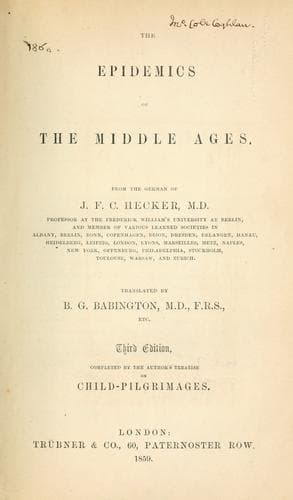
The Epidemics of the Middle AgesHecker, J. F. C. (Justus Friedrich Carl)
History
The Epidemics of the Middle Ages
Hecker, J. F. C. (Justus Friedrich Carl)
Black Death; Epidemics -- History; Hysteria, Epidemic
The Abyssinian Zoomorphism is a no less important phenomenon, and shows
itself in a manner quite peculiar. The blacksmiths and potters form,
among the Abyssinians, a society, or caste called in Tigrè _Tebbib_,
and in Amhara _Buda_, which is held in some degree of contempt, and
excluded from the sacrament of the Lord’s Supper, because it is
believed that they can change themselves into hyænas and other beasts
of prey, on which account they are feared by every body, and regarded
with horror. They artfully contrive to keep up this superstition,
because by this separation they preserve a monopoly of their lucrative
trades, and as in other respects they are good Christians, (but few
Jews or Mahomedans live among them,) they seem to attach no great
consequence to their excommunication. As a badge of distinction, they
wear a golden earring, which is frequently found in the ears of hyænas
that are killed, without its having ever been discovered how they catch
these animals, so as to decorate them with this strange ornament,
and this removes, in the minds of the people, all doubt as to the
supernatural powers of the smiths and potters[322]. To the budas is
also ascribed the gift of enchantment, especially that of the influence
of the evil eye[323]. They nevertheless live unmolested, and are not
condemned to the flames by fanatical priests, as the lycanthropes were
in the middle ages.
CHAPTER IV.
SYMPATHY.
Imitation—compassion—sympathy, these are imperfect designations for a
common bond of union among human beings—for an instinct which connects
individuals with the general body, which embraces with equal force,
reason and folly, good and evil, and diminishes the praise of virtue
as well as the criminality of vice. In this impulse there are degrees,
but no essential differences, from the first intellectual efforts of
the infant mind, which are in a great measure based on imitation, to
that morbid condition of the soul in which the sensible impression of
a nervous malady fetters the mind, and finds its way, through the eye,
directly to the diseased texture, as the electric shock is propagated
by contact from body to body. To this instinct of imitation, when it
exists in its highest degree, is united a loss of all power over the
will, which occurs as soon as the impression on the senses has become
firmly established, producing a condition like that of small animals
when they are fascinated by the look of a serpent. By this mental
bondage, morbid sympathy is clearly and definitely distinguished from
all subordinate degrees of this instinct, however closely allied the
imitation of a disorder may seem to be to that of a mere folly, of an
absurd fashion, of an awkward habit in speech and manner, or even of a
confusion of ideas. Even these latter imitations, however, directed as
they are to foolish and pernicious objects, place the self-independence
Public-domain text, read in full here on John Shaqi.
Reviews
Reviews
No reviews yet
Be the first to share your thoughts on this work.
Elsewhere in the archive
Join the Discussion
Join the discussion
Sign in to leave a comment or review.
Sign InorCreate an account