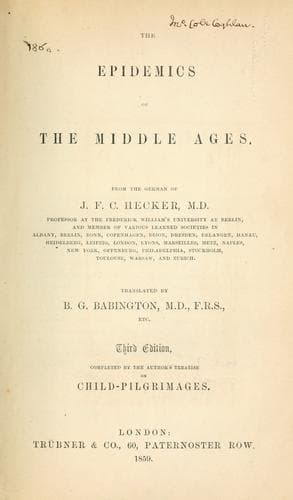
The Epidemics of the Middle AgesHecker, J. F. C. (Justus Friedrich Carl)
History
The Epidemics of the Middle Ages
Hecker, J. F. C. (Justus Friedrich Carl)
Black Death; Epidemics -- History; Hysteria, Epidemic
of the greater portion of mankind in a very doubtful light, and account
for their union into a social whole. Still more nearly allied to morbid
sympathy than the imitation of enticing folly, although often with
a considerable admixture of the latter, is the diffusion of violent
excitements, especially those of a religious or political character,
which have so powerfully agitated the nations of ancient and modern
times, and which may, after an incipient compliance[324], pass into a
total loss of power over the will, and an actual disease of the mind.
Far be it from us to attempt to awaken all the various tones of this
chord, whose vibrations reveal the profound secrets which lie hid in
the inmost recesses of the soul. We might well want powers adequate
to so vast an undertaking. Our business here is only with that morbid
sympathy, by the aid of which the dancing mania of the middle ages grew
into a real epidemic. In order to make this apparent by comparison, it
may not be out of place, at the close of this inquiry, to introduce a
few striking examples:—
1. “At a cotton manufactory at Hodden Bridge, in Lancashire, a girl, on
the fifteenth of February 1787, put a mouse into the bosom of another
girl, who had a great dread of mice. The girl was immediately thrown
into a fit, and continued in it, with the most violent convulsions, for
twenty-four hours. On the following day, three more girls were seized
in the same manner; and on the 17th, six more. By this time, the alarm
was so great, that the whole work, in which 200 or 300 were employed,
was totally stopped, and an idea prevailed that a particular disease
had been introduced by a bag of cotton opened in the house. On Sunday
the 18th, Dr. St. Clare was sent for from Preston; before he arrived
three more were seized, and during that night and the morning of the
19th, eleven more, making in all twenty-four. Of these, twenty-one
were young women, two were girls of about ten years of age, and one
man, who had been much fatigued with holding the girls. Three of the
number lived about two miles from the place where the disorder first
broke out, and three at another factory at Clitheroe, about five miles
distant, which last and two more were infected entirely from report,
not having seen the other patients, but, like them and the rest of the
country, strongly impressed with the idea of the plague being caught
from the cotton. The symptoms were anxiety, strangulation, and very
strong convulsions; and these were so violent as to last without any
intermission from a quarter of an hour to twenty-four hours, and to
require four or five persons to prevent the patients from tearing their
hair and dashing their heads against the floor or walls. Dr. St. Clare
had taken with him a portable electrical machine, and by electric
shocks the patients were universally relieved without exception. As
soon as the patients and the country were assured that the complaint
Public-domain text, read in full here on John Shaqi.
Reviews
Reviews
No reviews yet
Be the first to share your thoughts on this work.
Elsewhere in the archive
Join the Discussion
Join the discussion
Sign in to leave a comment or review.
Sign InorCreate an account