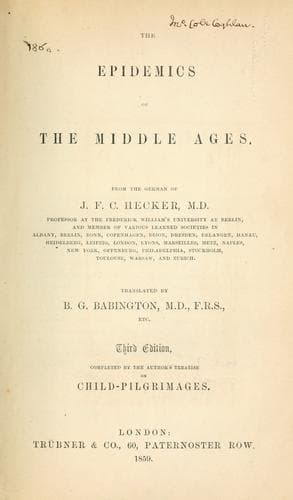
The Epidemics of the Middle AgesHecker, J. F. C. (Justus Friedrich Carl)
History
The Epidemics of the Middle Ages
Hecker, J. F. C. (Justus Friedrich Carl)
Black Death; Epidemics -- History; Hysteria, Epidemic
was merely nervous, easily cured, and not introduced by the cotton,
no fresh person was affected. To dissipate their apprehensions still
further, the best effects were obtained by causing them to take a
cheerful glass and join in a dance. On Tuesday the 20th, they danced,
and the next day were all at work, except two or three, who were much
weakened by their fits.”[325]
The occurrence here described is remarkable on this account, that there
was no important predisposing cause for convulsions in these young
women, unless we consider as such their miserable and confined life
in the work-rooms of a spinning manufactory. It did not arise from
enthusiasm, nor is it stated that the patients had been the subjects
of any other nervous disorders. In another perfectly analogous case,
those attacked were all suffering from nervous complaints, which
roused a morbid sympathy in them at the sight of a person seized with
convulsions. This, together with the supervention of hysterical fits,
may aptly enough be compared to Tarantism.
2. “A young woman of the lowest order, twenty-one years of age, and
of a strong frame, came on the 13th of January, 1801, to visit a
patient in the Charité hospital at Berlin, where she had herself
been previously under treatment for an inflammation of the chest
with tetanic spasms, and immediately on entering the ward, fell down
in strong convulsions. At the sight of her violent contortions, six
other female patients immediately became affected in the same way,
and by degrees eight more were in like manner attacked with strong
convulsions. All these patients were from sixteen to twenty-five years
of age, and suffered without exception, one from spasms in the stomach,
another from palsy, a third from lethargy, a fourth from fits with
consciousness, a fifth from catalepsy, a sixth from syncope, &c. The
convulsions, which alternate in various ways with tonic spasms, were
accompanied by loss of sensibility, and were invariably preceded by
languor with heavy sleep, which was followed by the fits in the course
of a minute or two; and it is remarkable, that in all these patients
their former nervous disorders, not excepting paralysis, disappeared,
returning, however, after the subsequent removal of their new
complaint. The treatment, during the course of which two of the nurses,
who were young women, suffered similar attacks, was continued for four
months. It was finally successful, and consisted principally in the
administration of opium, at that time the favourite remedy[326].”
Public-domain text, read in full here on John Shaqi.
Reviews
Reviews
No reviews yet
Be the first to share your thoughts on this work.
Elsewhere in the archive
Join the Discussion
Join the discussion
Sign in to leave a comment or review.
Sign InorCreate an account