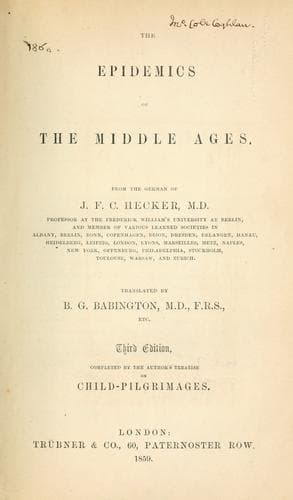
The Epidemics of the Middle AgesHecker, J. F. C. (Justus Friedrich Carl)
History
The Epidemics of the Middle Ages
Hecker, J. F. C. (Justus Friedrich Carl)
Black Death; Epidemics -- History; Hysteria, Epidemic
Now, every species of enthusiasm, every strong affection, every violent
passion, may lead to convulsions—to mental disorders—to a concussion of
the nerves, from the sensorium to the very finest extremities of the
spinal chord. The whole world is full of examples of this afflicting
state of turmoil, which, when the mind is carried away by the force
of a sensual impression that destroys its freedom, is irresistibly
propagated by imitation. Those who are thus infected do not spare even
their own lives, but, as a hunted flock of sheep will follow their
leader and rush over a precipice, so will whole hosts of enthusiasts,
deluded by their infatuation, hurry on to a self-inflicted death. Such
has ever been the case, from the days of the Milesian virgins to the
modern associations for self-destruction[327]. Of all enthusiastic
infatuations, however, that of religion is the most fertile in
disorders of the mind as well as of the body, and both spread with the
greatest facility by sympathy. The history of the church furnishes
innumerable proofs of this, but we need go no further than the most
recent times.
3. In a Methodist chapel at Redruth, a man during divine service, cried
out with a loud voice, “What shall I do to be saved?” at the same
time manifesting the greatest uneasiness and solicitude respecting
the condition of his soul. Some other members of the congregation,
following his example, cried out in the same form of words, and seemed
shortly after to suffer the most excruciating bodily pain. This strange
occurrence was soon publicly known, and hundreds of people, who had
come thither, either attracted by curiosity, or a desire, from other
motives, to see the sufferers, fell into the same state. The chapel
remained open for some days and nights, and from that point the new
disorder spread itself, with the rapidity of lightning, over the
neighbouring towns of Camborne, Helston, Truro, Penryn, and Falmouth,
as well as over the villages in the vicinity. Whilst thus advancing,
it decreased in some measure at the place where it had first appeared,
and it confined itself throughout to the Methodist chapels. It was
only by the words which have been mentioned that it was excited, and it
seized none but people of the lowest education. Those who were attacked
betrayed the greatest anguish, and fell into convulsions; others cried
out, like persons possessed, that the Almighty would straightway pour
out his wrath upon them, that the wailings of tormented spirits rang in
their ears, and that they saw hell open to receive them. The clergy,
when in the course of their sermons, they perceived that persons
were thus seized, earnestly exhorted them to confess their sins, and
zealously endeavoured to convince them that they were by nature enemies
to Christ; that the anger of God had therefore fallen upon them; and
that if death should surprise them in the midst of their sins, the
eternal torments of hell would be their portion. The over-excited
Public-domain text, read in full here on John Shaqi.
Reviews
Reviews
No reviews yet
Be the first to share your thoughts on this work.
Elsewhere in the archive
Join the Discussion
Join the discussion
Sign in to leave a comment or review.
Sign InorCreate an account