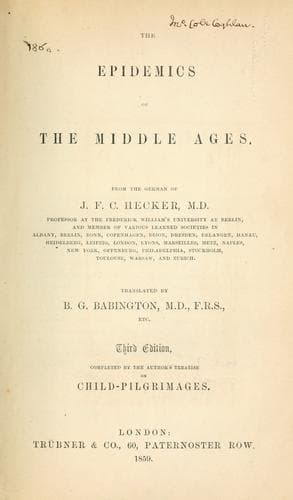
The Epidemics of the Middle AgesHecker, J. F. C. (Justus Friedrich Carl)
History
The Epidemics of the Middle Ages
Hecker, J. F. C. (Justus Friedrich Carl)
Black Death; Epidemics -- History; Hysteria, Epidemic
congregation upon this repeated their words, which naturally must have
increased the fury of their convulsive attacks. When the discourse had
produced its full effect, the preacher changed his subject; reminded
those who were suffering, of the power of the Saviour, as well as
of the grace of God, and represented to them in glowing colours the
joys of heaven. Upon this a remarkable reaction sooner or later took
place. Those who were in convulsions felt themselves raised from the
lowest depths of misery and despair to the most exalted bliss, and
triumphantly shouted out that their bonds were loosed, their sins were
forgiven, and that they were translated to the wonderful freedom of the
children of God. In the mean time, their convulsions continued, and
they remained, during this condition, so abstracted from every earthly
thought, that they staid two and sometimes three days and nights
together in the chapels, agitated all the time by spasmodic movements,
and taking neither repose nor nourishment. According to a moderate
computation, 4000 people were, within a very short time, affected with
this convulsive malady.
The course and symptoms of the attacks were in general as
follows:—There came on at first a feeling of faintness, with rigour
and a sense of weight at the pit of the stomach, soon after which
the patient cried out, as if in the agonies of death or the pains
of labour. The convulsions then began, first showing themselves in
the muscles of the eyelids, though the eyes themselves were fixed
and staring. The most frightful contortions of the countenance
followed, and the convulsions now took their course downwards, so that
the muscles of the neck and trunk were affected, causing a sobbing
respiration, which was performed with great effort. Tremors and
agitation ensued, and the patients screamed out violently, and tossed
their heads about from side to side. As the complaint increased, it
seized the arms, and its victims beat their breasts, clasped their
hands, and made all sorts of strange gestures. The observer who gives
this account remarked that the lower extremities were in no instance
affected. In some cases, exhaustion came on in a very few minutes,
but the attack usually lasted much longer, and there were even cases
in which it was known to continue for sixty or seventy hours. Many of
those who happened to be seated when the attack commenced, bent their
bodies rapidly backwards and forwards during its continuance, making a
corresponding motion with their arms, like persons sawing wood. Others
shouted aloud, leaped about, and threw their bodies into every possible
posture, until they had exhausted their strength. Yawning took place
at the commencement in all cases, but as the violence of the disorder
increased, the circulation and respiration became accelerated, so
that the countenance assumed a swollen and puffed appearance. When
exhaustion came on, patients usually fainted, and remained in a stiff
Public-domain text, read in full here on John Shaqi.
Reviews
Reviews
No reviews yet
Be the first to share your thoughts on this work.
Elsewhere in the archive
Join the Discussion
Join the discussion
Sign in to leave a comment or review.
Sign InorCreate an account