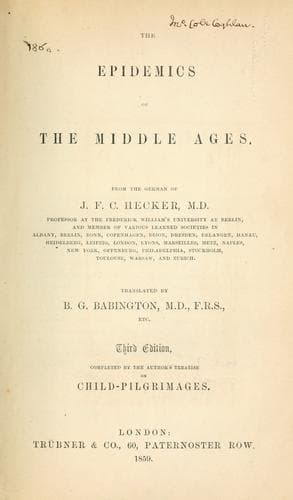
The Epidemics of the Middle AgesHecker, J. F. C. (Justus Friedrich Carl)
History
The Epidemics of the Middle Ages
Hecker, J. F. C. (Justus Friedrich Carl)
Black Death; Epidemics -- History; Hysteria, Epidemic
and motionless state until their recovery. The disorder completely
resembled the St. Vitus’s dance, but the fits sometimes went on to
an extraordinarily violent extent, so that the author of the account
once saw a woman, who was seized with these convulsions, resist the
endeavours of four or five strong men to restrain her. Those patients
who did not lose their consciousness were in general made more furious
by every attempt to quiet them by force, on which account they were in
general suffered to continue unmolested until nature herself brought
on exhaustion. Those affected complained, more or less, of debility
after the attacks, and cases sometimes occurred in which they passed
into other disorders: thus some fell into a state of melancholy, which,
however, in consequence of their religious ecstacy, was distinguished
by the absence of fear and despair; and in one patient inflammation of
the brain is said to have taken place. No sex or age was exempt from
this epidemic malady. Children five years old and octogenarians were
alike affected by it, and even men of the most powerful frame were
subject to its influence. Girls and young women, however, were its most
frequent victims[328].
4. For the last hundred years a nervous affection of a perfectly
similar kind has existed in the Shetland Islands, which furnishes
a striking example, perhaps the only one now existing, of the very
lasting propagation by sympathy of this species of disorders. The
origin of the malady was very insignificant. An epileptic woman had a
fit in church, and whether it was that the minds of the congregation
were excited by devotion, or that, being overcome at the sight of
the strong convulsions, their sympathy was called forth, certain it
is, that many adult women, and even children, some of whom were of
the male sex, and not more than six years old, began to complain
forthwith of palpitation, followed by faintness, which passed into a
motionless and apparently cataleptic condition. These symptoms lasted
more than an hour, and probably recurred frequently. In the course of
time, however, this malady is said to have undergone a modification,
such as it exhibits at the present day. Women whom it has attacked
will suddenly fall down, toss their arms about, writhe their bodies
into various shapes, move their heads suddenly from side to side, and
with eyes fixed and staring, utter the most dismal cries. If the fit
happen on any occasion of public diversion, they will, as soon as it
has ceased, mix with their companions and continue their amusement as
if nothing had happened. Paroxysms of this kind used to prevail most
during the warm months of summer, and about fifty years ago there was
scarcely a Sabbath in which they did not occur. Strong passions of
the mind, induced by religious enthusiasm, are also exciting causes
of these fits, but like all such false tokens of divine workings,
they are easily encountered by producing in the patient a different
Public-domain text, read in full here on John Shaqi.
Reviews
Reviews
No reviews yet
Be the first to share your thoughts on this work.
Elsewhere in the archive
Join the Discussion
Join the discussion
Sign in to leave a comment or review.
Sign InorCreate an account