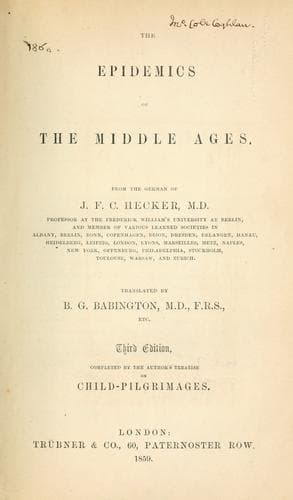
The Epidemics of the Middle AgesHecker, J. F. C. (Justus Friedrich Carl)
History
The Epidemics of the Middle Ages
Hecker, J. F. C. (Justus Friedrich Carl)
Black Death; Epidemics -- History; Hysteria, Epidemic
frame of mind, and especially by exciting a sense of shame: thus those
affected are under the control of any sensible preacher, who knows
how to “administer to a mind diseased,” and to expose the folly of
voluntarily yielding to a sympathy so easily resisted, or of inviting
such attacks by affectation. An intelligent and pious minister of
Shetland informed the physician, who gives an account of this
disorder as an eye-witness, that being considerably annoyed, on his
first introduction into the country, by these paroxysms, whereby the
devotions of the church were much impeded, he obviated their repetition
by assuring his parishioners, that no treatment was more effectual than
immersion in cold water; and as his kirk was fortunately contiguous to
a freshwater lake, he gave notice that attendants should be at hand,
during divine service, to ensure the proper means of cure. The sequel
need scarcely be told. The fear of being carried out of the church,
and into the water, acted like a charm; not a single Naiad was made,
and the worthy minister, for many years, had reason to boast of one of
the best regulated congregations in Shetland. As the physician above
alluded to was attending divine service in the kirk of Baliasta, on
the Isle of Unst, a female shriek, the indication of a convulsion fit,
was heard; the minister, Mr. Ingram, of Fetlar, very properly stopped
his discourse, until the disturber was removed; and, after advising
all those who thought they might be similarly affected, to leave the
church, he gave out, in the meantime, a psalm. The congregation was
thus preserved from further interruption; yet the effect of sympathy
was not prevented, for as the narrator of the account was leaving the
church, he saw several females writhing and tossing about their arms on
the green grass, who durst not, for fear of a censure from the pulpit,
exhibit themselves after this manner within the sacred walls of the
kirk[329].
In the production of this disorder, which no doubt still exists,
fanaticism certainly had a smaller share than the irritable state of
women out of health, who only needed excitement, no matter of what
kind, to throw them into the prevailing nervous paroxysms. When,
however, that powerful cause of nervous disorders takes the lead, we
find far more remarkable symptoms developed, and it then depends on the
mental condition of the people among whom they appear, whether in their
spread, they shall take a narrow or an extended range—whether confined
to some small knot of zealots they are to vanish without a trace, or
whether they are to attain even historical importance.
Public-domain text, read in full here on John Shaqi.
Reviews
Reviews
No reviews yet
Be the first to share your thoughts on this work.
Elsewhere in the archive
Join the Discussion
Join the discussion
Sign in to leave a comment or review.
Sign InorCreate an account