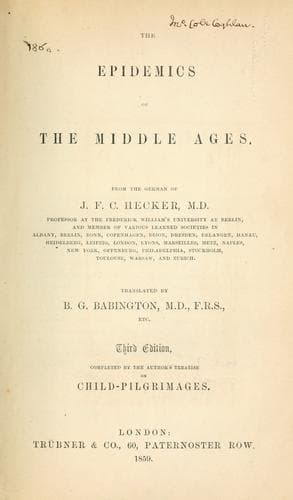
The Epidemics of the Middle AgesHecker, J. F. C. (Justus Friedrich Carl)
History
The Epidemics of the Middle Ages
Hecker, J. F. C. (Justus Friedrich Carl)
Black Death; Epidemics -- History; Hysteria, Epidemic
5. The appearance of the _Convulsionnaires_ in France, whose
inhabitants, from the greater mobility of their blood, have in
general been the less liable to fanaticism, is, in this respect,
instructive and worthy of attention. In the year 1727 there died, in
the capital of that country, the Deacon Pâris, a zealous opposer of the
Ultramontanists, division having arisen in the French church on account
of the bull “Unigenitus.” People made frequent visits to his tomb, in
the cemetery of St. Medard, and four years afterwards, (in September,
1731,) a rumour was spread, that miracles took place there. Patients
were seized with convulsions and tetanic spasms, rolled upon the ground
like persons possessed, were thrown into violent contortions of their
heads and limbs, and suffered the greatest oppression, accompanied by
quickness and irregularity of pulse. This novel occurrence excited
the greatest sensation all over Paris, and an immense concourse of
people resorted daily to the above named cemetery, in order to see
so wonderful a spectacle, which the Ultramontanists immediately
interpreted as a work of Satan, while their opponents ascribed it to a
divine influence. The disorder soon increased, until it produced, in
nervous women, _clairvoyance_, (_Schlafwachen_,) a phenomenon till then
unknown; for one female especially attracted attention, who blindfold,
and, as it was believed, by means of the sense of smell, read every
writing that was placed before her, and distinguished the characters of
unknown persons. The very earth taken from the grave of the Deacon, was
soon thought to possess miraculous power. It was sent to numerous sick
persons at a distance, whereby they were said to have been cured, and
thus this nervous disorder spread far beyond the limits of the capital,
so that at one time it was computed that there were more than eight
hundred decided _Convulsionnaires_, who would hardly have increased
so much in numbers, had not Louis XV. directed that the cemetery
should be closed[330]. The disorder itself assumed various forms,
and augmented, by its attacks, the general excitement. Many persons,
besides suffering from the convulsions, became the subjects of violent
pain, which required the assistance of their brethren of the faith. On
this account they, as well as those who afforded them aid, were called
by the common title of _Secourists_. The modes of relief adopted were
remarkably in accordance with those which were administered to the
St. John’s dancers and the Tarantati, and they were in general very
rough; for the sufferers were beaten and goaded in various parts of
the body with stones, hammers, swords, clubs, &c., of which treatment
the defenders of this extraordinary sect relate the most astonishing
examples, in proof that severe pain is imperatively demanded by nature
in this disorder, as an effectual counter-irritant. The Secourists used
wooden clubs, in the same manner as paviors use their mallets, and it
Public-domain text, read in full here on John Shaqi.
Reviews
Reviews
No reviews yet
Be the first to share your thoughts on this work.
Elsewhere in the archive
Join the Discussion
Join the discussion
Sign in to leave a comment or review.
Sign InorCreate an account