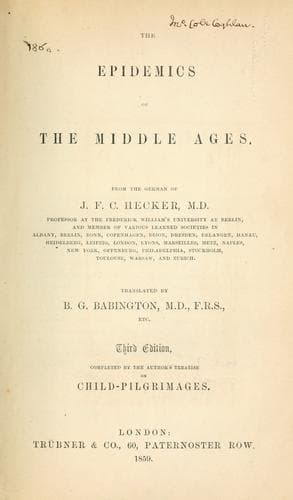
The Epidemics of the Middle AgesHecker, J. F. C. (Justus Friedrich Carl)
History
The Epidemics of the Middle Ages
Hecker, J. F. C. (Justus Friedrich Carl)
Black Death; Epidemics -- History; Hysteria, Epidemic
Item die ghene die die kranckheit hadden wurden gemeynlichen gesunt
bynnen. VV. dagen. Zom lesten geschiede vill bouerie vnd droch dae mit.
Eyndeyll naemen sich an dat Sij kranck weren. vp dat Sij mochten gelt
dae durch bedelen. Die anderen vinsden sich kranck vp dat Sij mochten
vnkuyschheit bedrijuen mit den vrauwen. jnd gyngen durch alle lant ind
dreuen vill bouerie. Doch zo lesten brach idt vyss ind wurden verdreuen
vyss den landen. Die selue dentzer quamen ouch zo Coellen tusschen
tzwen vnser lieuen frauwen missen Assumptionis ind Natiuitatis.
V.
In the third volume of the Edinburgh Medical and Surgical Journal,
p. 434, there is an account of “some convulsive diseases in certain
parts of Scotland, which is taken from Sir J. Sinclair’s statistical
account, and from which I have thought it illustrative of our author’s
subject to make some extracts; the first that is noticed is peculiar to
a part of Forfarshire, and is called the leaping ague, which bears so
close an analogy to the original St. Vitus’s Dance, or to Tarantism,
that it seems to want only the “foul fiend,” or the dreaded bite, as
a cause, and a Scotch reel or strathspey as a cure, to render the
resemblance quite complete. “Those affected with it first complain
of a pain in the head, or lower part of the back, to which succeed
convulsive fits, or _fits of dancing_, at certain periods. During the
paroxysm they have all the appearance of madness, distorting their
bodies in various ways, and leaping and springing in a surprising
manner, whence the disease has derived its vulgar name. Sometimes they
run with astonishing velocity, and often over dangerous passes, to
some place out of doors, which they have fixed on in their own minds,
or, perhaps, even mentioned to those in company with them, and then
_drop down quite exhausted_. At other times, especially when confined
to the house, they climb in the most singular manner. In cottages, for
example, they leap from the floor to what is called the baulks, or
those beams by which the rafters are joined together, springing from
one to another with the agility of a cat, or whirling round one of
them, with a motion resembling the fly of a jack. Cold bathing is found
to be the most effectual remedy; but when the fit of dancing, leaping,
or running comes on, _nothing tends so much to abate the violence of
the disease, as allowing them free scope to exercise themselves, till
nature be exhausted_. No mention is made of its being peculiar to any
age, sex, or condition of life, although I am informed by a gentleman
from Brechin, that it is most common before puberty. In some families
it seems to be hereditary; and I have heard of one, in which a horse
was always kept ready saddled, to follow the young ladies belonging to
it, when they were seized with a fit of running. It was first observed
in the parish of Kenmuir, and has prevailed occasionally in that and
Public-domain text, read in full here on John Shaqi.
Reviews
Reviews
No reviews yet
Be the first to share your thoughts on this work.
Elsewhere in the archive
Join the Discussion
Join the discussion
Sign in to leave a comment or review.
Sign InorCreate an account