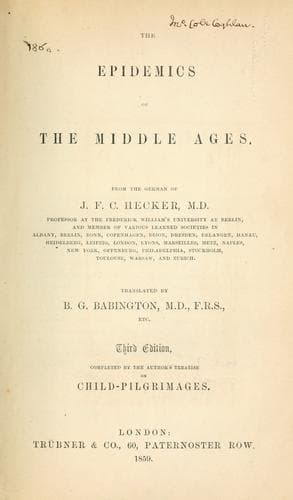
The Epidemics of the Middle AgesHecker, J. F. C. (Justus Friedrich Carl)
History
The Epidemics of the Middle Ages
Hecker, J. F. C. (Justus Friedrich Carl)
Black Death; Epidemics -- History; Hysteria, Epidemic
the neighbouring parishes, for about seventy years: but it is not now
nearly so frequent as it was about thirty years ago. The history of
this singular affection is still extremely imperfect: and it is only
from some of the medical practitioners in that part of the country
where it prevails, that a complete description can be expected.”
Our author has already noticed the convulsive disease prevalent in
the Shetland Islands, and has quoted Hibbert’s account of it. The
following, however, from a very valuable manuscript account of the
Orkney and Shetland Islands, drawn up about 1774, by George Low, with
notes, by Mr. Pennant, is given in the journal already cited, and will
be read with interest. The facts were communicated to Mr. Low by the
Rev. Wm. Archibald, parochial clergyman of Unst, the most northerly of
the Shetlands.
“There is a most shocking distemper, which has of late years prevailed
very much, especially among young women, and was hardly known thirty
or forty years ago. About that period only one person was subject to
it. The inhabitants give it the name of convulsion fits; and indeed,
in appearance it something resembles epilepsy. In its first rise, it
began with a palpitation of the heart, of which they complained for a
considerable time; it at length produced swooning fits, in which people
seized with it would lie motionless upwards of an hour. At length, as
the distemper gathered strength, when any violent passion seized, or
on a sudden surprise, they would all at once fall down, toss their
arms about, with their bodies, into many odd shapes, crying out all
the while most dismally, throwing their heads about from side to side,
with their eyes fixed and staring. At first this distemper obtained
in a private way, with one female, but she being seized in a public
way, at church, the disease was communicated to others; but, whether
by the influence of _fear_ or _sympathy_, is not easy to determine.
However this was, our public assemblies, especially at church, became
greatly disturbed by their outcries. This distemper always prevails
most violently during the summer time, in which season, for many years,
we are hardly one sabbath free. In these few years past, it has not
prevailed so extensively, and upon the whole, seems on the decline.
One thing remarkable in this distemper is, that as soon as the fit is
over, the persons affected with it are generally as lively and brisk
as before; and if it happens at any of their public diversions, as
soon as they revive, they mix with their companions, and continue
their amusement as vigorously as if nothing had happened. Few men are
troubled with this distemper, which seems more confined to women; but
there are instances of its seizing men, and girls of six years of
age. With respect to the nature of this disease, people who have made
enquiry about it differ, but most imagine it hysterical; however, this
seems not entirely the case, as men and children are subject to it;
Public-domain text, read in full here on John Shaqi.
Reviews
Reviews
No reviews yet
Be the first to share your thoughts on this work.
Elsewhere in the archive
Join the Discussion
Join the discussion
Sign in to leave a comment or review.
Sign InorCreate an account