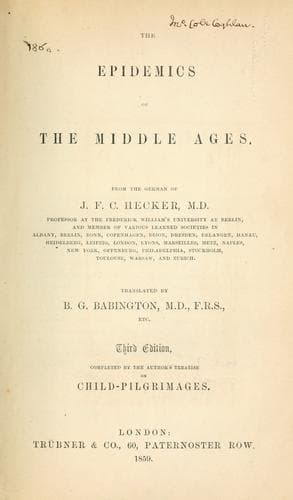
The Epidemics of the Middle AgesHecker, J. F. C. (Justus Friedrich Carl)
History
The Epidemics of the Middle Ages
Hecker, J. F. C. (Justus Friedrich Carl)
Black Death; Epidemics -- History; Hysteria, Epidemic
however, it is a new disease in Shetland, but whence imported, none can
imagine.
“When the statistical account of this parish was published, this awful
and afflicting disease was becoming daily less common. In the parishes
of Aithsting, Sandsting, and Northmaven, in which it was once very
frequent, it was now totally extinct. In the last of these the cure is
said to have been effected by a very singular remedy, which, if true,
and there seems no reason to doubt it, shows the influence of moral
causes in removing, as well as in inducing convulsive disorders.” The
cure is attributed to a rough fellow of a kirk officer, who tossed a
woman in that state, with whom he had been frequently troubled, into a
ditch of water. She was never known to have the disease afterwards, and
others dreaded the same treatment.
“It, however, still prevails in some of the northern parishes,
particularly in Delting, although, according to the description given
of it, with some alteration in its symptoms.
“Convulsion fits of a very extraordinary kind seem peculiar to this
country. The patient is first seized with something like fainting, and
immediately after utters wild cries and shrieks, the sound of which, at
whatever distance, immediately puts all who are subject to the disorder
in the same situation. It most commonly attacks them when the church
is crowded, and often interrupts the service in this and many other
churches in the country. On a sacramental occasion, fifty or sixty
are sometimes carried out of the church, and laid in the churchyard,
where they struggle and roar with all their strength, for five or ten
minutes, and then rise up without recollecting a single circumstance
that happened to them, or being in the least hurt or fatigued with
the violent exertions they had made during the fit. One observation
occurs on this disorder, that, during the late scarce years it was
very uncommon, and, during the two last years of plenty (1791), it has
appeared more frequently.
“Similar instances of epidemical convulsions are already upon record;
but the history of that which occurred in Anglesea, North Wales, is the
most remarkable, as its progress was, in all probability, checked by
the judicious precautions recommended by Dr. Haygarth.
Public-domain text, read in full here on John Shaqi.
Reviews
Reviews
No reviews yet
Be the first to share your thoughts on this work.
Elsewhere in the archive
Join the Discussion
Join the discussion
Sign in to leave a comment or review.
Sign InorCreate an account