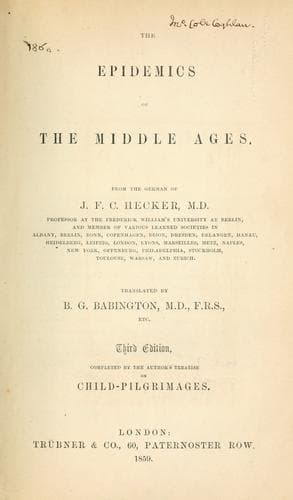
The Epidemics of the Middle AgesHecker, J. F. C. (Justus Friedrich Carl)
History
The Epidemics of the Middle Ages
Hecker, J. F. C. (Justus Friedrich Carl)
Black Death; Epidemics -- History; Hysteria, Epidemic
“In 1796, on the estates of the Earl of Uxbridge and Holland Griffith,
Esq., 23 females, from 10 to 25, and one boy, of about 17 years of age,
who had all intercourse with each other, were seized with an unusual
kind of convulsions, affecting only the upper extremities. It began
with pain of the head, and sometimes of the stomach and side, not very
violent; after which there came on violent twitchings or convulsions of
the upper extremities, continuing with little intermission, and causing
the shoulders almost to meet by the exertion. In bed the disorder was
not so violent: but, in some cases at least, it continued even during
sleep. Their pulse was moderate, the body costive, and the general
health not much impaired. In general they had a hiccough; and, when
the convulsions were most violent, giddiness came on, with the loss
of hearing and recollection. During their convalescence, and they
all recovered, the least fright or sudden alarm brought on a slight
paroxysm.
“Dr. Haygarth, who was consulted on the means of relieving these
unfortunate people, successfully recommended the use of antispasmodics;
that all girls and young women should be prevented from having any
communication with persons affected with those convulsions; and that
those who were ill should be kept separate as much as possible.”
The same paper from which the above extracts have been taken, quotes
a remarkable instance in which religious enthusiasm was the exciting
cause of a convulsive disease analogous to those already noticed. The
account is given by the Rev. Dr. Meik, at great length. It appears,
that in January, 1742, about 90 persons in the parish of Cambuslang,
in Lanarkshire, were induced to subscribe a petition to the minister,
urging him to give them a weekly lecture, to which he readily assented.
Nothing particular occurred at the first two lectures, but, at the
third, to which the hearers had been very attentive, when the minister
in his last prayer expressed himself thus, “Lord, who hath believed
our report; and to whom is the arm of the Lord revealed?—where are the
fruits of my poor labours among this people?” several persons in the
congregation cried out publicly, and about fifty men and women came
to the minister’s house, expressing strong convictions of sin, and
alarming fears of punishment. After this period, so many people from
the neighbourhood resorted to Cambuslang, that the minister thought
himself obliged to provide them with daily sermons or exhortations,
and actually did so for seven or eight months. The way in which the
converts were affected, for it seems they were affected much in the
same way, though in very different degrees, is thus described. “They
were seized, all at once, commonly by something said in the sermons or
prayers, with the most dreadful apprehensions concerning the state of
their souls, insomuch that many of them could not abstain from crying
out, in the most public and frightful manner, ‘bewailing their lost
Public-domain text, read in full here on John Shaqi.
Reviews
Reviews
No reviews yet
Be the first to share your thoughts on this work.
Elsewhere in the archive
Join the Discussion
Join the discussion
Sign in to leave a comment or review.
Sign InorCreate an account