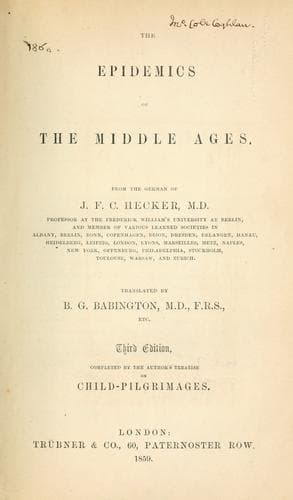
The Epidemics of the Middle AgesHecker, J. F. C. (Justus Friedrich Carl)
History
The Epidemics of the Middle Ages
Hecker, J. F. C. (Justus Friedrich Carl)
Black Death; Epidemics -- History; Hysteria, Epidemic
and undone condition by nature; calling themselves enemies to God,
and despisers of precious Christ; declaring that they were unworthy
to live on the face of the earth; that they saw the mouth of hell
open to receive them, and that they heard the shrieks of the damned;’
but the universal cry was, ‘What shall we do to be saved?’ The agony
under which they laboured was expressed, not only by words, but also
by violent agitations of body; by clapping their hands and beating
their breasts; by shaking and trembling; by faintings and convulsions;
and sometimes by excessive bleeding at the nose. While they were in
this distress, the minister often called out to them, not to stifle or
smother their convictions, but to encourage them: and, after sermon
was ended, he retired with them to the manse, and frequently spent the
best part of the night with them in exhortations and prayers. Next day,
before sermon began, they were brought out, and, having napkins tied
round their heads, were placed all together on seats before the tents,
where they remained sobbing, weeping, and often crying aloud, till the
service was over. Some of those who fell under conviction were never
converted; but most of those who fell under it were converted in a few
days, and sometimes in a few hours. In most cases their conversion
was as sudden and unexpected as their conviction. They were raised all
at once from the lowest depth of sorrow and distress, to the highest
pitch of joy and happiness; crying out with triumph and exultation,
‘that they had overcome the wicked one; that they had gotten hold of
Christ, and would never let him go; that the black cloud which had
hitherto concealed him from their view was now dispelled; and that
they saw him, with a pen in his hand, blotting out their sins.’ Under
these delightful impressions, some began to pray, and exhort publicly,
and others desired the congregation to join with them in singing a
particular psalm, which they said God had commanded them to sing.
From the time of their conviction to their conversion, many had no
appetite for food, or inclination to sleep, and all complained of their
sufferings during that interval.”
The following account, which closes the paper whence the above
quotations have been extracted, is taken from an Inaugural Essay on
Chorea Sancti Viti, by Felix Robertson of Tennessee, 8vo. Philadelph.
1805.
“The Chorea, which is more particularly the subject of this
dissertation, made its appearance during the summer of 1803, in the
neighbourhood of Maryville, (Tennessee,) in the form of an epidemic.
Previously to entering on its history, I think it necessary to premise
a few cursory remarks on the mode of life of those amongst whom it
originated, for some time before the appearance of the disease.
Public-domain text, read in full here on John Shaqi.
Reviews
Reviews
No reviews yet
Be the first to share your thoughts on this work.
Elsewhere in the archive
Join the Discussion
Join the discussion
Sign in to leave a comment or review.
Sign InorCreate an account