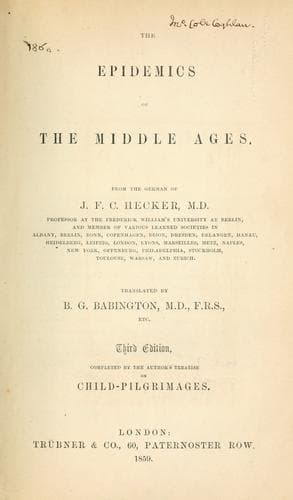
The Epidemics of the Middle AgesHecker, J. F. C. (Justus Friedrich Carl)
History
The Epidemics of the Middle Ages
Hecker, J. F. C. (Justus Friedrich Carl)
Black Death; Epidemics -- History; Hysteria, Epidemic
All these events so rapidly succeeded each other in the course of
three weeks, that the knights and soldiers of Richmond, more and
more excited every day by fear and hope, were scarcely equal to such
exertions. Yet the very rapidity of the movements of the army was the
cause why the disease could not spread so quickly, nor obstruct the
final decision of Bosworth, although the report of it had already,
before this event, spread universal terror; so that Lord Stanley, when
authoritatively summoned by Richard to repair to his standard, sought
to gain time, and, by way of excuse, alleged the prevalence of the new
disease[362].
After the victory of Bosworth, King Henry remained two days in
Leicester, and then without further delay hastened to London, which he
reached in less than four days, unaccompanied by military parade, and
attended only by a select body of followers. The remainder of his army,
which stood greatly in need of repose after its severe toils, were not
in a condition for marching, they therefore halted in the neighbouring
towns, and were probably disbanded, according to the custom of the
age[363].
The Sweating Sickness is said not to have made its appearance in London
till the 21st of September[364], but historians have most likely
intended by that day to mark the commencement of its virulence, which
continued to the end of the following month, and lasted, therefore, in
all, about five weeks.
During this short period a large portion of the population[365] fell
victims to the new epidemic, and the lamentation was without bounds
so long as the people were ignorant that this fearful disease, unable
to establish its dominion, would only pass through the country like a
flash of lightning, and then again give place to the active intercourse
of society and the cheering hope of life.
There was no security against a second attack; for many who had
recovered were seized by it, with equal violence, a second, and
sometimes a third time, so that they had not even the slender
consolation enjoyed by sufferers in the plague[366] and small-pox, of
entire immunity after having once surmounted the danger[367].
Thus by the end of the year the disease had spread over the whole
of England, and visited every place with the same severity as the
metropolis. Many persons of rank, of the ecclesiastical and the civil
classes, became its victims; and great was the consternation when, in
the month of August, it broke out in Oxford. Professors and students
fled in all directions: but death overtook many of them, and this
celebrated university was deserted for six weeks[368]. Three months
later it appeared at Croyland, and on the 14th of November, carried off
Lambert Fossedyke, abbot of the monastery[369]. No authentic accounts
from other quarters have been handed down to our times, but we may
infer, from the general grief and anxiety which prevailed, that the
loss of human life was very considerable.
SECT. 2.—THE PHYSICIANS.
Public-domain text, read in full here on John Shaqi.
Reviews
Reviews
No reviews yet
Be the first to share your thoughts on this work.
Elsewhere in the archive
Join the Discussion
Join the discussion
Sign in to leave a comment or review.
Sign InorCreate an account