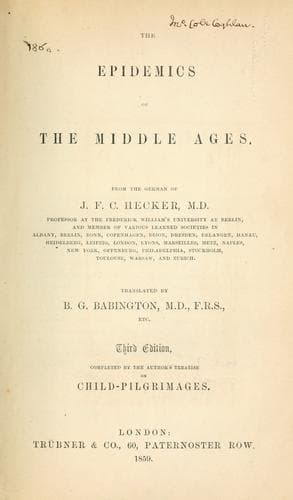
The Epidemics of the Middle AgesHecker, J. F. C. (Justus Friedrich Carl)
History
The Epidemics of the Middle Ages
Hecker, J. F. C. (Justus Friedrich Carl)
Black Death; Epidemics -- History; Hysteria, Epidemic
The physicians could do little or nothing for the people in this
extremity[370]. They are nowhere alluded to throughout this epidemic,
and even those who might have come forward to succour their fellow
citizens, had fallen into the errors of Galen, and their dialectic
minds sank under this appalling phenomenon. This holds good even of
the famous Thomas Linacre, subsequently physician in ordinary to two
monarchs[371], and founder of the College of Physicians, in 1518.
In the prime of his youth he had been an eye-witness of the events
at Oxford, and survived even the second and third eruption of the
Sweating Sickness; but in none of his writings do we find a single word
respecting this disease, which is of such permanent importance. In
fact, the restorers of the medical science of ancient Greece, who were
followed by all the most enlightened men in Europe, with the single
exception of Linacre, occupied themselves rather with the ancient terms
of art than with actual observation, and in their critical researches
overlooked the important events that were passing before their
eyes[372]. This reminds us of the later Greek physicians, who for four
hundred years paid no attention to the small-pox, because they could
find no description of it in the immortal works of Galen[373].
No resource was therefore left to the terrified people of England but
their own good sense, and this led them to the adoption of a plan of
treatment, than which no physician in the world could have given them
a better; namely, not to resort to any violent medicines, but to apply
moderate heat, to abstain from food, taking only a small quantity of
mild drink, and quietly to wait for four-and-twenty hours the crisis
of this formidable malady. Those who were attacked during the day, in
order to avoid any chill, immediately went to bed in their clothes,
and those who sickened by night did not rise from their beds in the
morning; while all carefully avoided exposing to the air even a hand or
foot. Thus they anxiously guarded against heat or cold, so as not to
excite perspiration by the former, nor to check it by the latter—for
they well knew that either was certain death[374].
The report of the infallibility of this method soon spread over
the whole kingdom, and thus towards the commencement of 1486, many
were rescued from death. On New Year’s Day, a violent tempest arose
in the south-east, and by purifying the atmosphere relieved the
oppression under which the people laboured, and thus, to the joy of
the whole nation, the epidemic was swept away without leaving a trace
behind[375].
SECT. 3.—CAUSES.
Public-domain text, read in full here on John Shaqi.
Reviews
Reviews
No reviews yet
Be the first to share your thoughts on this work.
Elsewhere in the archive
Join the Discussion
Join the discussion
Sign in to leave a comment or review.
Sign InorCreate an account