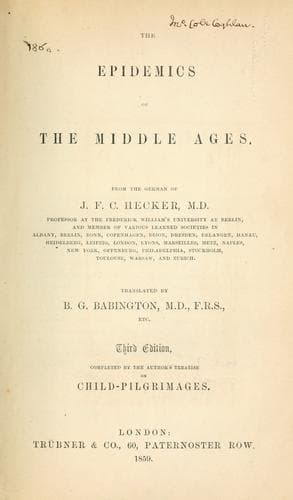
The Epidemics of the Middle AgesHecker, J. F. C. (Justus Friedrich Carl)
History
The Epidemics of the Middle Ages
Hecker, J. F. C. (Justus Friedrich Carl)
Black Death; Epidemics -- History; Hysteria, Epidemic
than it really was, it would have found the most striking confirmation
in the sudden cessation of the pestilence throughout the whole country.
For the destructive spirits of air, which would not have been discerned
even by the proud naturalists of the nineteenth century, dispersed and
vanished for half an age in the fury of the tempest which raged on the
1st of January, 1486.
CHAPTER II.
THE SECOND VISITATION OF THE DISEASE.—1506.
“The times were rough and full of mutations and rare
incidents.”—_Bacon_.
SECT. 1.—MERCENARY TROOPS.
At the commencement of the sixteenth century, society was very
differently constituted from what it was at the period when Henry the
VIIth unfurled his banner for victory. The darkness of the middle ages
had receded, as at the approach of a sun still hidden behind a cloud.
The mind unconsciously expanded in the unwonted light of day—the whole
earth was on the eve of renovation—new energies were to be called into
action—events more stupendous had never occurred, nor had more creative
ideas ever aroused the spirit of man. The invention of Gutenberg
burst through the bonds of mental darkness, and gave to freedom of
thought imperishable wings; unsuspected powers successively developed
themselves; and, while in Western Europe an ardent desire arose boldly
to overstep the ancient limits of human activity, the hopes of the more
enlightened fell far short of the actual result of such unexpected
events. The discovery of the New World, and the circumnavigation of
Africa, laid the foundation for great improvements; yet the events
in Central Europe, though less striking to contemporaries, were in
their consequences, infinitely more important and beneficial. The
establishment of civil order among all the nations of the West took
place at this period, which forms so important a boundary between the
middle ages and modern times. Regal power was fixed on a firm basis,
and when the castles had fallen before the artillery of the princes
and imperial cities, so that the petty feudal barons were compelled to
swear obedience to the laws, an end was put to the incessant predatory
feuds which had so long desolated Europe, and the establishment of
internal peace was followed by the security of life and property—the
first essential of refinement in manners and of the free development of
human society.
Public-domain text, read in full here on John Shaqi.
Reviews
Reviews
No reviews yet
Be the first to share your thoughts on this work.
Elsewhere in the archive
Join the Discussion
Join the discussion
Sign in to leave a comment or review.
Sign InorCreate an account