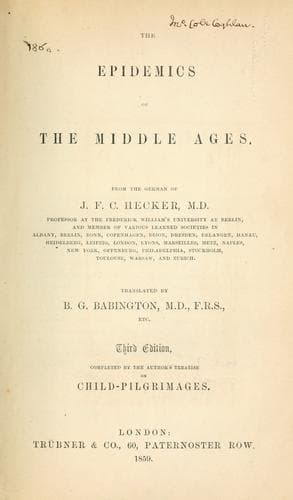
The Epidemics of the Middle AgesHecker, J. F. C. (Justus Friedrich Carl)
History
The Epidemics of the Middle Ages
Hecker, J. F. C. (Justus Friedrich Carl)
Black Death; Epidemics -- History; Hysteria, Epidemic
This great result of a concatenation of circumstances was not, however,
brought about without violent struggles and innovations, the effects of
which were felt for centuries; but it was probably _the establishment
of standing armies_ which had the greatest influence on European
civilization. They became indeed the pillars of civil order, but having
proceeded immediately from the pernicious mercenary system, they long
nourished the seeds of unrestrained depravity, and transmitted to later
generations the corruptions of the middle ages. The Lansquenets[402]
(Landsknechte) of the emperor, and the mercenaries of the kings of
France and England, who, during the war, had joined the smaller
branches of the standing army, were homeless adventurers from every
country in Europe, and were allured, not by military ambition, but
solely by the prospect of booty[403]. In whatever country the drum
beat to arms, they flocked together like swarms of locusts—no one knew
from whence—and defying the feeble restraints of military discipline,
indulged, during the continuance of the war, in all the unbridled
licence of a predatory life.
Hence the unbounded barbarity of their mode of warfare, which was
restrained only by the individual exertions of more humane commanders.
There was, however, a decided contrariety between this system and
the moral condition of the people of Western Europe: a contrariety
which was never entirely removed by the subsequent introduction of a
more strict military discipline, and which has been done away only
in modern times, by the establishment of regular armies on a system
more congenial to the feelings of the people. Hence the consequences
were the more pernicious, for when the armies were disbanded on the
conclusion of peace, the Landsknechts dispersed in all directions, not
to follow the plough again, or to resume their former occupations, but
to pass their time in idleness and dissipation, if enriched by booty,
and if reduced to poverty by intemperance and gambling, to infest the
country as mendicants or robbers, till a new war again summoned them
from their dishonourable mode of life[404]. Probably but very few were
ever able to rise from such deep degradation, and many fell early
victims to their vices[405], while the infection of their example
brought fresh accessions from every town and village to the mercenary
legions.
SECT. 2.—NEW CIRCUMSTANCES.
Public-domain text, read in full here on John Shaqi.
Reviews
Reviews
No reviews yet
Be the first to share your thoughts on this work.
Elsewhere in the archive
Join the Discussion
Join the discussion
Sign in to leave a comment or review.
Sign InorCreate an account