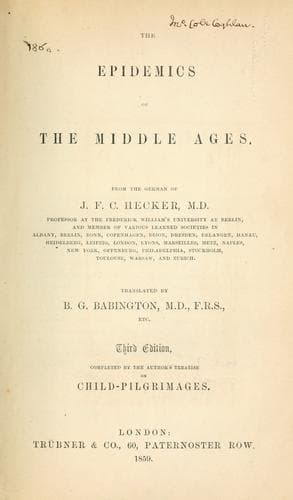
The Epidemics of the Middle AgesHecker, J. F. C. (Justus Friedrich Carl)
History
The Epidemics of the Middle Ages
Hecker, J. F. C. (Justus Friedrich Carl)
Black Death; Epidemics -- History; Hysteria, Epidemic
It is evident that in such a condition of affairs, the effect which
the plague produced on civil society must have been different from
that of former times. Pernicious influences which, during the middle
ages, had endangered the health of the inhabitants of towns, and had
often rendered disorders, naturally slight, in the highest degree
malignant, were for ever removed. Under this head may be mentioned
more particularly the ill-contrived construction of the houses and
streets, which even yet, in large cities, destroys the comfort of the
inhabitants of whole districts, and those not of the poorest class
only. As people acquired confidence in the security of peace, it ceased
to be necessary to protect every country town by fortifications.
The walls were thrown down, the stagnant moats were filled up, and
as people were no longer limited to a narrow space, they built more
convenient houses in airy streets; the dark alleys and damp dwellings
under ground were gradually abandoned, and a more comfortable mode of
living superseded the former misery. By this means the mortality was
considerably diminished, and the power of epidemics was checked; nor
can it be doubted, that the better administration of the laws greatly
obviated the dissolution of social ties in times of plague, and the
effects of superstition and religious animosity, which had formerly
been so frightful. These inestimable national improvements, however,
took place but gradually, and were not a little retarded for a time by
the new evil of the employment of mercenaries. For as the germs of vice
were scattered in all directions by the wandering Lansquenets, so also
the infection of noxious diseases found easier entrance into the towns
and villages through the medium of this dissolute and widely spread
class of men. The Lansquenets of the sixteenth century, as spreaders
of contagion, supplied the place of the former Romish pilgrims and
flagellants; they even proved a more permanent scourge than those
wanderers of the middle ages, who only made their appearance on
extraordinary occasions. We need here only call to mind the malignant
and beyond measure noisome lues which at the end of the fifteenth
century spread with the rapidity of lightning over all Europe. It was
not an importation from the innocent inhabitants of the New World, nor
was it bred by the ill-treated Marrani[406], the victims of the Spanish
Inquisition. It was the mercenary army of Charles the VIIIth in Naples
(1495), whose excesses gave to the already existing poison a malignity
till then unknown, and prepared for the deeply rooted depravity, a
scourge at which all the world shuddered with horror. It is, moreover,
in place here to observe that, in the larger armies which the new
military system now brought into the field, the ordinary camp diseases,
to which another very fatal one was added[407], were of course much
more extensively propagated than in the less numerous forces of
Public-domain text, read in full here on John Shaqi.
Reviews
Reviews
No reviews yet
Be the first to share your thoughts on this work.
Elsewhere in the archive
Join the Discussion
Join the discussion
Sign in to leave a comment or review.
Sign InorCreate an account