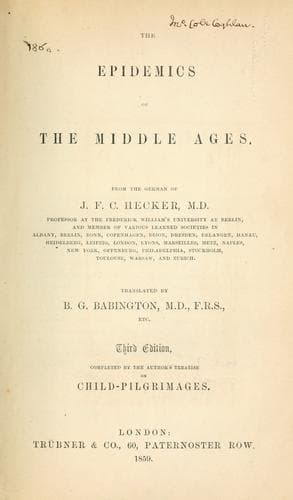
The Epidemics of the Middle AgesHecker, J. F. C. (Justus Friedrich Carl)
History
The Epidemics of the Middle Ages
Hecker, J. F. C. (Justus Friedrich Carl)
Black Death; Epidemics -- History; Hysteria, Epidemic
preceding centuries, and consequently that the peaceful inhabitants
of the towns and of the country at large were thereby exposed to much
danger.
SECT. 3.—SWEATING SICKNESS.
Meantime Europe was frequently and very severely visited by the
epidemics of the middle ages, the terrors of the constantly recurring
plague being borne with gloomy resignation to the inevitable evil
with which, as a merited chastisement, the anger of God, according
to the notion of the times, afflicted the human race. Even the
English were not exempt from this fearful visitation, which, in the
year 1499, carried off 30,000 people in London alone, so that the
king found it advisable to retire with all his court to Calais[408].
Thus the recollection of the Sweating Sickness of 1485 was gradually
obliterated. No one thought of its possible return, and all the world
was occupied with other matters, when the old enemy unexpectedly again
raised his head in the summer of 1506, and scared away this comfortable
state of false security. The renewed eruption of the epidemic was not,
on this occasion, connected with any important occurrence, so that
contemporaries have not even mentioned the month in which it began
to rage. Towards the autumn it had again disappeared, and as no new
symptoms were added to the disease, the form of which was identified
by a reference to the old descriptions, it was immediately treated by
the same means, the efficacy of which those who had witnessed the
epidemic of 1485 lauded with so much reason[409]. Every exposure to
heat or cold was, as at that time, avoided, and the malignant fever
was left to the curative powers of nature, the patient being kept
moderately warm in bed; and no powerful medicines being administered.
The result was beyond all expectation favourable, for in few houses did
any fatal cases occur. The victory over this dreaded enemy was now, by
a pardonable error, attributed more to human skill than to the mildness
of the malady on this occasion, which, even under a less judicious
treatment of the sick, would certainly not have been marked by any
considerable degree of severity.
The disease broke out in London, but whether it penetrated to the
west or not, contemporary writers, being soon convinced of its slight
character, have left us no intelligence. However widely it may have
spread, it certainly was confined to England, and nowhere occasioned
any great mortality.
SECT. 4.—ACCOMPANYING PHENOMENA.
Public-domain text, read in full here on John Shaqi.
Reviews
Reviews
No reviews yet
Be the first to share your thoughts on this work.
Elsewhere in the archive
Join the Discussion
Join the discussion
Sign in to leave a comment or review.
Sign InorCreate an account