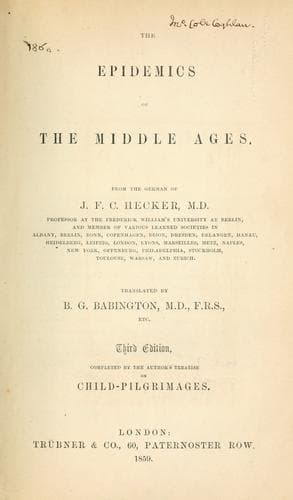
The Epidemics of the Middle AgesHecker, J. F. C. (Justus Friedrich Carl)
History
The Epidemics of the Middle Ages
Hecker, J. F. C. (Justus Friedrich Carl)
Black Death; Epidemics -- History; Hysteria, Epidemic
As the epidemic was on this occasion so very mild, it was not
accompanied by any remarkable phenomena in England, but the case was
otherwise in the rest of Europe, as will be proved by the following
details. After a wet summer, in the year 1505, a severe winter set
in[410]. Comets were seen in this as in the following year. An
eruption of Vesuvius also took place in 1506[411], which may be
mentioned, although it is well established that volcanic commotions
are to be taken into account only in great pestilences, not in less
extensive epidemics. In England there blew a violent storm from the
south-west, from the 15th till the 26th of January, 1506, which drove
the king of Castille, Philip of Austria, with his consort Johanna,
from the Netherlands to Weymouth; and as, some days before, a golden
eagle falling from St. Paul’s church, in London, had crushed a black
eagle which ornamented some lower building, evil predictions were
promulgated among the people respecting the fate of this son of the
emperor[412]. This event, however, could not be considered as at all
connected with the pestilence which broke out about half a year
afterwards. More consideration is due to the gloom and anxiety which
at that time depressed the spirit of the English nation. The reckless
avarice of Henry the VIIth, named the English Solomon[413], gave just
ground for doubts regarding the security of property; and the pious
foundations—those accustomed means of softening the dreaded wrath of
heaven, which the king, who became gradually more and more broken
down by disease, established, could not efface the recollection of
the arbitrary violence and extortions of his corrupt servants[414].
Although these extortions principally affected the wealthy nobility,
who were much in need of restraint, yet dark mistrust was general,
and all cheerfulness was banished from the minds of the people. This
state of feeling might have been favourable to the propagation of the
returning disease, but the genius of the year 1506 would not suffer it
to be more than a slight and transient reminiscence of a mystically
hidden danger, the import of which was not apparent to any medical
inquirer of the 16th century.
SECT. 5.—PETECHIAL FEVER IN ITALY, 1505.
Public-domain text, read in full here on John Shaqi.
Reviews
Reviews
No reviews yet
Be the first to share your thoughts on this work.
Elsewhere in the archive
Join the Discussion
Join the discussion
Sign in to leave a comment or review.
Sign InorCreate an account