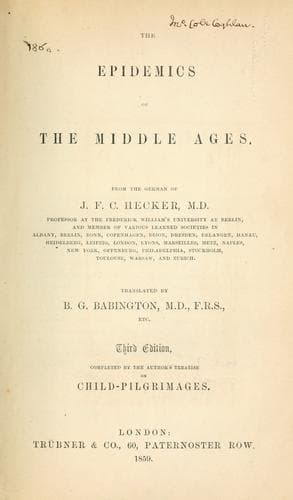
The Epidemics of the Middle AgesHecker, J. F. C. (Justus Friedrich Carl)
History
The Epidemics of the Middle Ages
Hecker, J. F. C. (Justus Friedrich Carl)
Black Death; Epidemics -- History; Hysteria, Epidemic
Thus, if we paid attention, as usual, only to the palpable occurrences
which take place on the earth and beneath its surface, the Sweating
Sickness of the above-mentioned year might appear to be unconnected
with more considerable commotions of organic life. The powers of
nature, however, are in their operations too subtle to be comprehended
by our dull senses and by the coarse mechanism of our organs; nay,
precisely at a time when neither the one nor the other indicate
any alteration around us, those operations bring to light the most
extraordinary phenomena in the human frame—that most sensitive index
of secret influences on life. This observation was fully confirmed at
the time of the first return of the sweating fever. For whilst this
disease remained confined to England, there appeared in the southern
and central parts of Europe a new and fatal epidemic, which thenceforth
visited these nations almost continually with intense malignity. This
was the petechial fever, a disease unknown to the older physicians,
which was first observed in 1490, in Granada, where it threatened to
annihilate the army of Ferdinand the Catholic, and made great havoc
also among the Saracens[415]. The bubo plague had immediately preceded
it, (1483, 1485, 1486, 1488, 1489, and 1490[416],) and it may with no
small probability be assumed that the petechial fever had resulted from
this as a peculiar variety, since in other countries also, fifteen
years later, the bubo plague degenerated in various ways, and examples
are not wanting in which particular forms or constituent parts of great
epidemics thus branch off from them, in the same manner as, under
favourable circumstances, these will combine together, and united into
one destructive whole, multiply the sources of danger.
Yet some contemporaries were of opinion that the petechial fever had
been brought over to Granada[417] by Venetian mercenaries from Cyprus,
where they had fought against the Turks, and where this disorder was
said to have been indigenous. Notwithstanding some good works[418]
already existing, this matter has need of a more thorough examination,
which might bring to light important and instructive results,
respecting the rise and spread of the petechial fever, and especially
respecting its relation to other plagues. Whatever may be held with
regard to the true origin of this fever, thus much is established,
that it was at first an independent European disease, and that, at the
commencement, having occupied the southern part of this quarter of the
world, it then became connected, in a manner as extraordinary as it was
worthy of observation, with the sweating sickness of the north; since
the nearly simultaneous eruption of the sweating fever in England, with
the great epidemic petechial fever in the year 1505, may be justly
attributed to an influence common to both, although unquestionably of
greater power in the latter.
Public-domain text, read in full here on John Shaqi.
Reviews
Reviews
No reviews yet
Be the first to share your thoughts on this work.
Elsewhere in the archive
Join the Discussion
Join the discussion
Sign in to leave a comment or review.
Sign InorCreate an account