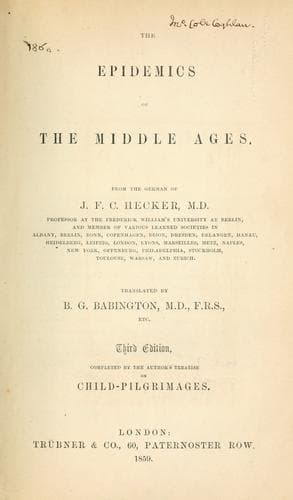
The Epidemics of the Middle AgesHecker, J. F. C. (Justus Friedrich Carl)
History
The Epidemics of the Middle Ages
Hecker, J. F. C. (Justus Friedrich Carl)
Black Death; Epidemics -- History; Hysteria, Epidemic
The epidemic petechial fever, of which we are now treating, prevailed
principally in Italy, and is described by Fracastoro as the first
plague of this kind which ever appeared in that country. Of this new
disease[419], which was placed by this great physician midway between
the bubo plague and the non-pestilential fever, the contagious quality
showed itself from the beginning; yet it was plainly perceived, that
the contagion did not take effect so quickly as in the bubo plague,
that it was not conveyed so easily by means of clothing and other
articles, and that physicians and attendants on the sick were the
only persons who incurred much danger of infection. The fever began
insidiously, and with very slight symptoms, so that the sick in
general did not so much as seek medical aid. Many persons, and even
physicians among the number, suffered themselves to be deceived by this
circumstance, and thus, not being aware of the danger, they hoped to
effect an easy cure, and were not a little astonished at the sudden
development of malignant phenomena. The heat was inconsiderable, in
proportion to the fever, yet those affected felt a certain inward
indisposition, a general depression of all the vital powers, and a
weariness as if after great exertion. They lay upon their backs with an
oppressed brain, their senses were blunted, and in most cases delirium
and gloomy muttering, with bloodshot eyes, commenced from the fourth
to the seventh day. The urine was usually clear and copious at the
beginning, it then became red and turbid, or resembling pomegranate
wine, (granatwein,) the pulse was slow and small, the evacuations
putrid and offensive, and either on the fourth or seventh day red
or purple spots, like flea-bites, or larger, or resembling lentils,
(lenticulæ,) which also gave a name to the disorder, broke out on the
arms, the back, and the breast. There was either no thirst at all, or
very little; the tongue was loaded, and in many cases a lethargic state
came on. Others, on the contrary, suffered from sleeplessness, or from
both these symptoms alternately. The disease reached its height on
the seventh or on the fourteenth day, and in some cases still later.
In many there existed a retention of urine with very unfavourable
prognosis. Women seldom died of this fever, elderly people still more
rarely, and Jews scarcely ever. Young people, on the other hand, and
children died in great numbers, and especially from among the higher
ranks, while the plague, on the contrary, used generally to commit its
ravages only among the poorer classes. An inordinate loss of power in
the commencement betokened death, as also a too violent effect from
mild aperient means, and a failure in alleviation after a complete
crisis. Patients were seen to die who had lost to the extent of three
pounds of blood from the nose. It was also a very bad sign when the
spots disappeared, or broke out tardily, or were of a blackish-blue
colour.
Public-domain text, read in full here on John Shaqi.
Reviews
Reviews
No reviews yet
Be the first to share your thoughts on this work.
Elsewhere in the archive
Join the Discussion
Join the discussion
Sign in to leave a comment or review.
Sign InorCreate an account