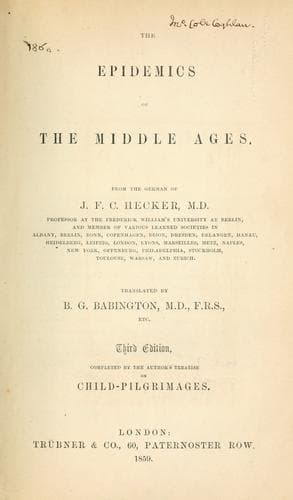
The Epidemics of the Middle AgesHecker, J. F. C. (Justus Friedrich Carl)
History
The Epidemics of the Middle Ages
Hecker, J. F. C. (Justus Friedrich Carl)
Black Death; Epidemics -- History; Hysteria, Epidemic
The ordinances of Henry the VIIth, which, although adapted to the
times, bore hard upon the people, soon produced their fruits. The great
diminished the number of their servants, and as, moreover, many of the
peasantry were thrown out of employment in consequence of a conversion
of large tracts of arable land into pasture[444], the population of
towns increased even to an overflow, and the consequent activity of
trade gradually rendered the towns flourishing. But this change took
place too rapidly. Wealth and luxury engendered, it is true, numerous
wants which were a source of gain, so that the English were at this
time considered luxurious and effeminate[445], but there was a general
scarcity of workmen and artists, and hence it happened, that from
Genoa, Lombardy, France, Germany and Holland, innumerable foreigners
immigrated and took possession of the most lucrative branches of
employment. This was a peculiar hardship on the natives, who from
their imperfect knowledge of the arts, could not compete with the more
skilful foreigners, and were besides treated by them with insolence and
contempt. The distresses of the poor thus increased yearly, and their
indignation at length broke out. A great insurrection of the English
artisans arose throughout London, and might have proved destructive to
the foreigners, had affairs been in a less orderly state. The popular
commotion was, however, suppressed without any considerable sacrifice,
and Henry the VIIIth on a solemn day, appointed at Westminster, for
passing judgment upon the prisoners, bestowed a pardon on them; for he
saw into the causes of their discontent, and very soon after caused
restrictive alien laws to be enacted[446].
SECT. 2.—SWEATING SICKNESS.
Public-domain text, read in full here on John Shaqi.
Reviews
Reviews
No reviews yet
Be the first to share your thoughts on this work.
Elsewhere in the archive
Join the Discussion
Join the discussion
Sign in to leave a comment or review.
Sign InorCreate an account