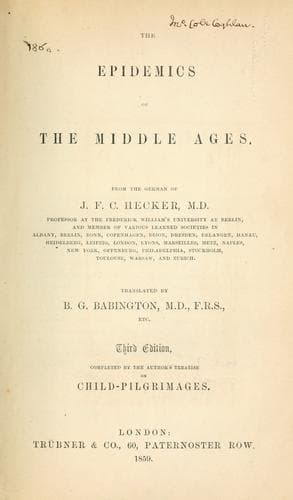
The Epidemics of the Middle AgesHecker, J. F. C. (Justus Friedrich Carl)
History
The Epidemics of the Middle Ages
Hecker, J. F. C. (Justus Friedrich Carl)
Black Death; Epidemics -- History; Hysteria, Epidemic
All this took place in April and May of the ever memorable year 1517,
and London was again indulging in hopes of better days, when the
Sweating Sickness once more broke out quite unexpectedly in July, and
in spite of all former experience, and the most sedulous attention,
inexorably demanded its victims. On this occasion it was so violent and
so rapid in its course, that it carried off those who were attacked in
two or three hours, so that the first shivering fit was regarded as the
announcement of certain death. It was not ushered in by any precursory
symptoms. Many who were in good health at noon, were numbered among
the dead by the evening, and thus as great a dread was created at
this new peril as ever was felt during the prevalence of the most
suddenly destructive epidemic: for the thought of being snatched away
from the full enjoyment of existence without any preparation, without
any hope of recovery, is appalling even to the bravest, and excites
secret trepidation and anguish. Among the lower classes the deaths
were innumerable[447]. The city was moreover crowded with poor; but
even the ranks of the higher classes were thinned, and no precaution
averted death from their palaces. Ammonius of Lucca, a scholar of
some celebrity, and in this capacity private secretary to the king,
was cut off in the flower of his age, after having boasted to Sir
Thomas More, only a few hours before his death, that by moderation
and good management he had secured both himself and his family from
the disease[448]. Also of those immediately about the king, Lords
Grey and Clinton were carried off, besides many knights, officers and
courtiers. Mourning supplanted the hilarity and brilliancy of the
festivals, and the king, while in miserable solitude, into which he
had retired with a few followers, received message after message from
different towns and villages, announcing, that in some a third, in
others even half the inhabitants were swept off by this pestilence.
It had never before raged with so much fatality. The minds of men had
never before been so frightfully appalled. The festival of Michaelmas,
(29th September,) which in England was always kept with much religious
pomp, was of necessity postponed; nor was the solemnity of Christmas
observed, for there was a dread of collecting together large assemblies
of people[449], on account of the contagion; and just about this time,
when the Sweating Sickness had abated, the plague, according to the
account of some historians, began, which, although probably not very
virulent, prevailed during the whole winter in most English towns,
and continued to keep up the distress of the people. The king on this
occasion also quitted his capital, and retreated, in company with a few
attendants, before the contagion, frequently shifting his court from
place to place. It was during this period of trouble (11th of February,
1518) that the Princess Mary, afterwards Queen, was born[450].
Public-domain text, read in full here on John Shaqi.
Reviews
Reviews
No reviews yet
Be the first to share your thoughts on this work.
Elsewhere in the archive
Join the Discussion
Join the discussion
Sign in to leave a comment or review.
Sign InorCreate an account