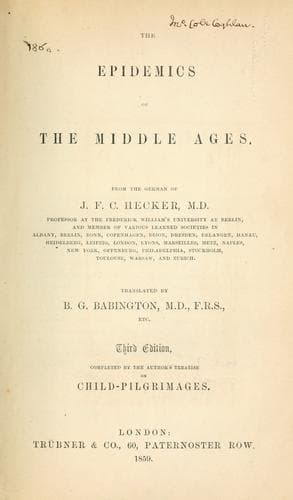
The Epidemics of the Middle AgesHecker, J. F. C. (Justus Friedrich Carl)
History
The Epidemics of the Middle Ages
Hecker, J. F. C. (Justus Friedrich Carl)
Black Death; Epidemics -- History; Hysteria, Epidemic
Thus the Sweating Sickness lasted full six months, reached its
greatest height[451] about six weeks after its appearance, and
probably spread from London over the whole of England. In Oxford and
Cambridge it raged with no less violence than in the capital. Most of
the inhabitants of those places were, in the course of a few days,
confined to their beds, and the sciences, which then flourished, for
they were never more zealously cultivated in England than at that time,
suffered severe losses by the death of many able and distinguished
scholars[452]. Scotland, Ireland and all other countries beyond sea,
were on this occasion spared. The neighbouring town of Calais alone was
reached[453] by the pestilence; and according to later observations,
it may be considered as certain, that only the English who resided
there, and not the French inhabitants, were affected, as it is also
ascertained that the rest of France continued throughout free from
the disease. Had this not been the case, contemporary writers would
undoubtedly not have omitted to make mention of so important an
occurrence.
SECT. 3.—CAUSES.
The influences which gave rise to this third eruption of the disorder
among the English nation are obscure, and do not altogether correspond
with those of the years 1485 and 1506. Thus it is especially
remarkable, that, on this occasion, there is no express mention of
the humidity which had so decided a share in the origin of the two
former visitations of the Sweating Sickness, and the year 1517 was in
most respects one of an ordinary kind. The English Chronicles state
nothing remarkable on the subject, and from those of Germany we only
learn that the winter of 1516 was very mild, and that a fruitful summer
with an abundant vintage[454] and a cold winter followed. The summer
of 1517 was unfruitful, although not on account of wet weather, so
that in some parts, especially in Swabia, provision was made against
a scarcity[455]. A great comet appeared in 1516[456], and in 1517 an
earthquake was felt at Tübingen, Nördlingen, and Calw, during a violent
storm, whereupon the “Haupt Krankheit”[457] (encephalitis), accompanied
by fever, became more prevalent, although not remarkably fatal[458].
This phenomenon (the earthquake) was by no means unimportant[459] in
its effects, and there is reason to suppose that it was followed by
subterraneous commotions of still greater extent, for earthquakes
occurred also in Spain[460]. As the date of this event is specified as
the 16th of June, and as earthquakes occurring in unusual localities,
that is to say, in districts not volcanic, are frequently cited as
prognostics of great diseases, although in volcanic districts they
evidently betoken nothing of the kind, we may hence with some reason
assume a telluric influence, which perhaps reached the locality of the
pestilence that broke out at the beginning of July, if not earlier.
Public-domain text, read in full here on John Shaqi.
Reviews
Reviews
No reviews yet
Be the first to share your thoughts on this work.
Elsewhere in the archive
Join the Discussion
Join the discussion
Sign in to leave a comment or review.
Sign InorCreate an account