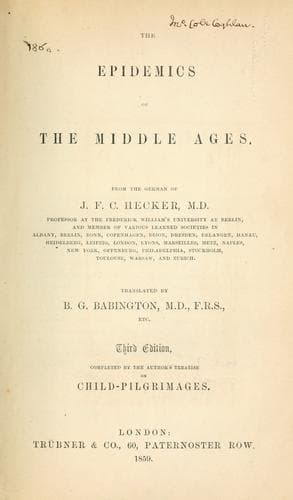
The Epidemics of the Middle AgesHecker, J. F. C. (Justus Friedrich Carl)
History
The Epidemics of the Middle Ages
Hecker, J. F. C. (Justus Friedrich Carl)
Black Death; Epidemics -- History; Hysteria, Epidemic
Besides, we cannot find any greater phenomenon, which, according to
human conception, could have had a more immediate connexion with the
English Sweating Sickness; and in this instance too, inquiry the most
circumspect does not penetrate through the thick veil which envelopes
the inscrutable causes of epidemics.
SECT. 4.—HABITS OF THE ENGLISH.
That next to the peculiar constitution which England imparts to her
inhabitants, the predisposing causes of the Sweating Sickness lay in
the habits of the English of those times, no one can possibly doubt.
The limitation of the pestilence to England plainly indicates this.
Not a single ship conveyed it to the French, or to the Dutch, who
breathed a much moister atmosphere; and yet the intercourse between the
English seaports and these immediately neighbouring nations was very
frequent. Of intemperance, which most generally lays the foundation
for disorders, both high and low were at this time accused. This vice
of the English was proverbial in foreign countries[461]. Flesh meats
highly seasoned with spices were indulged in to excess; noisy nocturnal
carousings were become customary, and it was also the practice to
drink strong wine[462] immediately after rising in the morning. Cyder,
which in some parts, as for instance in Devonshire, is the common
beverage[463], was, even in those times, considered by medical men
as injurious, for it was observed that its use caused debility with
paleness, and sapped the vigour of youth in both sexes[464]. Other
similar facts respecting the mode of living at that time might perhaps
be adduced, from which it would appear that, owing to the total want
of refinement in diet, much that was improper was employed in English
cookery, and that on this account the constitution was much injured.
Horticulture, which the French had already brought to a state of
great improvement[465], was still quite in its infancy in England.
It is even said that Queen Catherine had pot-herbs brought from
Holland for the preparation of salads, as they were not procurable in
England[466]. Allowing that this account may not be strictly true,
since it admits of other explanations, still it proves in itself what
we would here enforce, and leaves us to draw conclusions from it beyond
the mere fact of there being a scarcity of culinary vegetables. Much
more important, however, as respects our subject, was the custom of
wearing immoderately warm clothing, of which we have accounts worthy
of credence. From youth upwards the head was covered with thick
caps, in order to secure it from every chance of cold, and from the
least draught of air; and as, by this injurious practice, the brain
was subjected to a continual determination of blood, and a tenderness
of the skin was induced, there was no disorder more frequent among
the English in this century than catarrh[467], which was constantly
reproduced by relaxing perspirations and heating medicines. If this
Public-domain text, read in full here on John Shaqi.
Reviews
Reviews
No reviews yet
Be the first to share your thoughts on this work.
Elsewhere in the archive
Join the Discussion
Join the discussion
Sign in to leave a comment or review.
Sign InorCreate an account