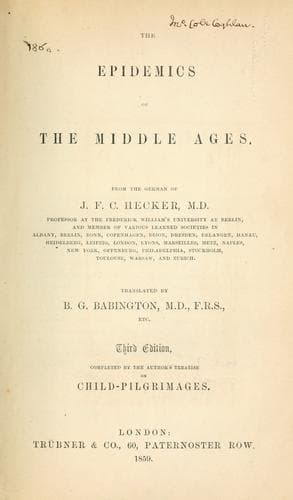
The Epidemics of the Middle AgesHecker, J. F. C. (Justus Friedrich Carl)
History
The Epidemics of the Middle Ages
Hecker, J. F. C. (Justus Friedrich Carl)
Black Death; Epidemics -- History; Hysteria, Epidemic
malady be complicated with a scorbutic habit, or if it befall persons
of debauched habits, whose vessels contain nourishment not properly
concocted, the preservative vital power seeks a vent through the
relaxed skin, and that which in itself is a needful and alleviating
excitement of this tissue becomes a disease; the wholesome excretion
degenerates into a colliquative drain, which forcibly carries off
with it unusual animal matters that ought not to pass away through
such an outlet, and the body yields to an attack to which it has been
thus long predisposed. When we consider this debilitated state of the
skin as the general complaint in England, taking into account the
prejudicial influence of hot baths[468], which were much in use, and
the diaphoretic medicines employed in most disorders; when we bear in
mind the rare use of soap at that time, and the high price of linen, as
also the extreme indigence of the lower classes, which almost always
breeds pestilences, the utterly miserable condition and truly Scythian
filth of the English habitations[469], and finally, the crowded state
of London in the year 1517, we shall, as far as human research can
penetrate, find the origin of the Sweating Sickness in this very year
explicable from causes which have long been known to be capable of
producing such effects. Something remains in the background, of which
hereafter.
SECT. 5.—CONTAGION.
The rapid spread of the Sweating Sickness all over England as far as
the Scottish borders, and across to Calais, now demands a more especial
consideration. Most fevers which are produced by general causes, as
well transient (epidemic) as constant and peculiar to the country
(endemic), or a union of both, which almost always takes place, and was
here evidently the case, propagate themselves for a time spontaneously.
The exhalations of the affected become the germs of a similar
decomposition in those bodies which receive them, and produce in these
a like attack upon the internal organs; and thus a merely morbid
phenomenon of life shews that it possesses the fundamental property
of all life, that of propagating itself in an appropriate soil. On
this point there is no doubt,—the phenomena which prove it have been
observed from time immemorial, in an endless variety of circumstances,
but always with a uniform manifestation of the fundamental law. All
nations too, and from the most ancient times, have invented ingenious
designations for these occurrences, which, however, seldom represent
the general notion, but commonly only the peculiar propagation of
individual diseases. Certainly one of the best and the most ingenious
is that which is conveyed by the German word “Ansteckung,” “setting
on fire,” which compares the exciting a disease in the appropriate
body, with the inflammation of combustible matter by the application
of fire, or with the kindling of powder by a spark. But how various
Public-domain text, read in full here on John Shaqi.
Reviews
Reviews
No reviews yet
Be the first to share your thoughts on this work.
Elsewhere in the archive
Join the Discussion
Join the discussion
Sign in to leave a comment or review.
Sign InorCreate an account