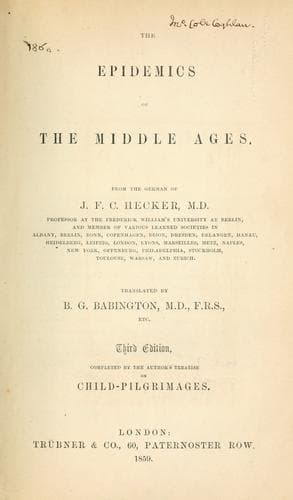
The Epidemics of the Middle AgesHecker, J. F. C. (Justus Friedrich Carl)
History
The Epidemics of the Middle Ages
Hecker, J. F. C. (Justus Friedrich Carl)
Black Death; Epidemics -- History; Hysteria, Epidemic
or later, when they betokened a favourable crisis. Thread-worms, in
great numbers, were evacuated alive under great torment, and generally
increased the sufferings of the patient. The disease was scarcely less
contagious than plague, and with respect to its treatment, bleeding,
copious and even ad deliquium, was decidedly successful, which coupled
with the attacks on the head just described[527], leads to the
conclusion that there existed a fulness of blood and an inflammatory
state of circulation, together, perhaps, with inflammation of the
brain. We must not omit to observe that, during the pestilence of 1546,
the bubo plague made its appearance here and there, especially in the
Netherlands[528]; and in the following year, broke out and spread to a
greater extent in France[529], whence it seems to follow, with respect
to the malady of which we are now treating, that its nature resembled
the petechial fever, since that disease usually precedes the occurrence
of pestilences[530].
The assertion of historians, that in 1528, and the following years,
France lost a fourth part of her inhabitants by famine and pestilence,
seems, according to our representation, not to be by any means
exaggerated. The consequences, as regarded the future destinies of that
country, were likewise very important. For Francis the 1st saw that no
new sacrifices could be borne by his people, who were already so sorely
afflicted; and therefore abandoned his schemes of greatness and foreign
power, consenting, on the 5th of August, 1529, to the disadvantageous
treaty of Cambray.
SECT. 3.—SWEATING SICKNESS IN ENGLAND, 1528.
Whoever, following the above facts, will represent to himself the
state of Europe in 1528, will readily believe, that a poisonous
atmosphere enveloped this quarter of the globe, and continually brought
destruction and death over its nations. Ruin broke in upon them in a
thousand forms, destroying their bodies and benighting their minds, and
if to this we add the discord and the deadly party hatred which at that
time prevailed in the world, it seems as if every circumstance that
could affect mankind was implicated in this gigantic conflict, which
threatened in its fatal result to annihilate all traces of the times
that were past.
Public-domain text, read in full here on John Shaqi.
Reviews
Reviews
No reviews yet
Be the first to share your thoughts on this work.
Elsewhere in the archive
Join the Discussion
Join the discussion
Sign in to leave a comment or review.
Sign InorCreate an account