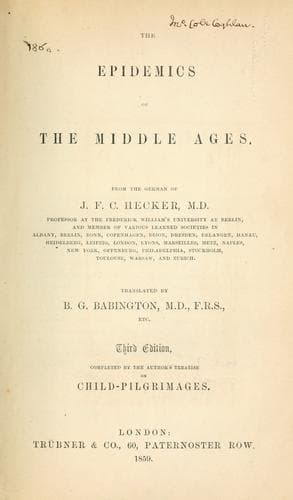
The Epidemics of the Middle AgesHecker, J. F. C. (Justus Friedrich Carl)
History
The Epidemics of the Middle Ages
Hecker, J. F. C. (Justus Friedrich Carl)
Black Death; Epidemics -- History; Hysteria, Epidemic
There dwelt a physician in Zwickau—we no longer know the name of this
estimable man—who, full of zeal for the good of mankind, opposed this
destructive folly. He went from house to house, and wherever he found
a patient buried in a hot bed, dragged him out with his own hands,
everywhere forbad that the sick should thus be tortured with heat, and
saved by his decisive conduct, many, who but for him, must have been
smothered like the rest[612]. It often happened, at this time, that
amidst a circle of friends, if the Sweating Sickness was only brought
to mind by a single word, first one, and then another was seized
with a tormenting anguish, their blood curdled, and certain of their
destruction, they quietly slunk away home, and there actually became a
prey to death[613]. This mortal fear is a heavy addition to the scourge
of rapidly fatal epidemics, and is, properly speaking, an inflammatory
disease of the mind, which, in its proximate effects upon the spirits,
bears some resemblance to the nightmare. It confuses the understanding,
so as to render it incapable of estimating external circumstances
according to their true relations to each other; it magnifies a gnat
into a monster, a distant improbable danger into a horrible spectre
which takes a firm hold of the imagination; all actions are perverted,
and if during this state of distraction, any other disease break out,
the patient conceives that he is the devoted victim of the much
dreaded epidemic, like those unfortunate persons, who, having been
bitten by a harmless animal, nevertheless become the subjects of an
imaginary hydrophobia. Thus, during the calamitous autumn of 1529,
many may have been seized with only an imaginary Sweating Sickness,
and under the towering heap of clothing on their loaded beds have met
with their graves[614]. Others among these brain-sick people who had
the good fortune to remain exempt from bodily ailments, many of them
even boasting of their firmness, fell, through the violent commotions
in their nerves, into a state of chronic hypochondriasis, which, under
circumstances of this sort, is marked by shuddering, and a feeling
of uneasiness and dread at the bare mention of the original cause of
terror, even when there is no longer any trace of its existence[615].
A person thus disordered in his mind, was recently seen to destroy
himself[616] on receiving false intelligence of the return of the
late epidemic; thus betraying conduct even more dastardly than those
cowardly soldiers, who, when the cannon begin to roar, inflict on
themselves slight wounds that they may avoid sharing the dangers of the
battle.
Public-domain text, read in full here on John Shaqi.
Reviews
Reviews
No reviews yet
Be the first to share your thoughts on this work.
Elsewhere in the archive
Join the Discussion
Join the discussion
Sign in to leave a comment or review.
Sign InorCreate an account