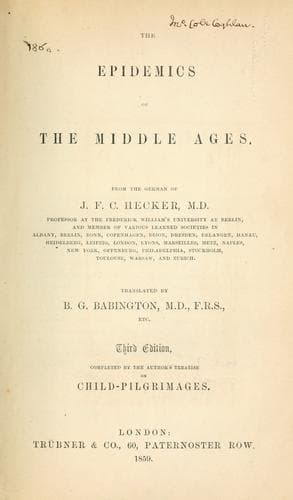
The Epidemics of the Middle AgesHecker, J. F. C. (Justus Friedrich Carl)
History
The Epidemics of the Middle Ages
Hecker, J. F. C. (Justus Friedrich Carl)
Black Death; Epidemics -- History; Hysteria, Epidemic
To have a full notion how men’s minds were previously prepared for this
state, we have but to think on the monstrous events which took place
in Germany. Twelve years earlier the gigantic work of the reformation
had been begun by the greatest German of that age, and, with the
Divine power of the gospel, triumphantly carried through up to that
period. The excitement was beyond all bounds. The new doctrine took
root in towns and villages, but nevertheless the most mortal party
hatred raged on all sides, and as usually happens in times of such
empassioned commotion, selfishness was the animating spirit which ruled
on both sides, and seized the torch of faith, in order, for her unholy
purposes, to envelop the world in fire and flames.
So early as the year 1521, during Luther’s concealment within the
walls of Wartburg, false prophets[617] arose, and desired, without the
aid of their great Master, who was the soul of that age, to complete
a work with the spirit of which they were not imbued. They brought
the wildest passions into action, but, destitute of innate firmness,
and incapable of curbing themselves, they became incendiaries and
iconoclasts. Immediately upon this the unhappy peasant-war broke out—a
consequence of the arbitrary conduct and oppression practised from
times of old, for which the abettors of Dr. Eck’s sentiments would
charge Luther himself as answerable; not perceiving that it was the
excitement of the times and of the false prophets which had given
occasion to the rebellion. Events occurred, from the recollection of
which human feeling still recoils. Never was the fair soil of Germany
the scene of more atrocious cruelties; and after vengeance had played
her insane part without opposition, the melancholy result was, that
hundreds of thousands of once peaceful, and for the most part misled
peasants, fell by the sword of the Lansquenets and of the executioner,
while their numerous survivors became a prey to the dearth which
visited the country in the following years. The battle of Frankenhausen
on the 15th of May, 1525, and Münzer’s subsequent execution, closed
this bloody scene. The consequences of such intestine commotions
continued however to be felt long after, and considered apart from
their highly prejudicial influence on the prosperity of the people,
conduced not a little to break the spirit of mankind, signs of which
the wise men of those times have plainly pointed out[618].
SECT. 9.—MORAL CONSEQUENCES.
Public-domain text, read in full here on John Shaqi.
Reviews
Reviews
No reviews yet
Be the first to share your thoughts on this work.
Elsewhere in the archive
Join the Discussion
Join the discussion
Sign in to leave a comment or review.
Sign InorCreate an account