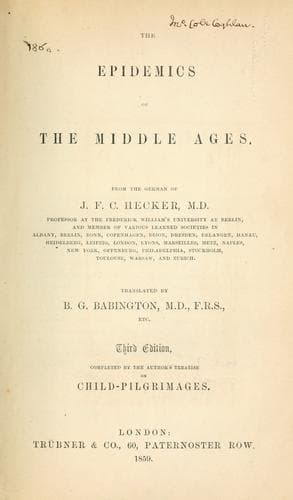
The Epidemics of the Middle AgesHecker, J. F. C. (Justus Friedrich Carl)
History
The Epidemics of the Middle Ages
Hecker, J. F. C. (Justus Friedrich Carl)
Black Death; Epidemics -- History; Hysteria, Epidemic
The affection of the stomach, often mentioned in vague terms, and
occasionally as a vomiting of blood, was doubtless only a subordinate
symptom, even if it be admitted that actual hematemesis did occur. For
the difficulty of distinguishing a flow of blood from the stomach, from
a pulmonic expectoration of that fluid, is, to non-medical men, even in
common cases, not inconsiderable. How much greater then must it have
been in so terrible a disease, where assistants could not venture to
approach the sick without exposing themselves to certain death? Only
two medical descriptions of the malady have reached us, the one by the
brave _Guy de Chauliac_, the other by _Raymond Chalin de Vinario_, a
very experienced scholar, who was well versed in the learning of his
time. The former takes notice only of fatal coughing of blood; the
latter, besides this, notices epistaxis, hematuria and fluxes of blood
from the bowels, as symptoms of such decided and speedy mortality, that
those patients in whom they were observed, usually died on the same or
the following day[31].
That a vomiting of blood may not, here and there, have taken
place, perhaps have been even prevalent in many places, is, from a
consideration of the nature of the disease, by no means to be denied;
for every putrid decomposition of the fluids begets a tendency to
hemorrhages of all kinds. Here, however, it is a question of historical
certainty, which, after these doubts, is by no means established. Had
not so speedy a death followed the expectoration of blood, we should
certainly have received more detailed intelligence respecting other
hemorrhages; but the malady had no time to extend its effects further
over the extremities of the vessels. After its first fury, however,
was spent, the pestilence passed into the usual febrile form of the
oriental plague. Internal carbuncular inflammations no longer took
place, and hemorrhages became phenomena, no more essential in this
than they are in any other febrile disorders. Chalin, who observed
not only the _great mortality_ of 1348, and the plague of 1360, but
also that of 1373 and 1382, speaks moreover of _affections of the
throat_, and describes the _black spots_ of plague patients more
satisfactorily than any of his contemporaries. The former appeared but
in few cases, and consisted in carbuncular inflammation of the gullet,
with a difficulty of swallowing, even to suffocation, to which, in
some instances, was added inflammation of the ceruminous glands of
the ears, with tumours, producing great deformity. Such patients, as
well as others, were affected with expectoration of blood; but they
did not usually die before the sixth, and sometimes, even so late as
the fourteenth day[32]. The same occurrence, it is well known, is not
uncommon in other pestilences; as also blisters on the surface of the
body, in different places, in the vicinity of which, tumid glands and
inflammatory boils, surrounded by discoloured and black streaks, arose,
Public-domain text, read in full here on John Shaqi.
Reviews
Reviews
No reviews yet
Be the first to share your thoughts on this work.
Join the Discussion
Join the discussion
Sign in to leave a comment or review.
Sign InorCreate an account