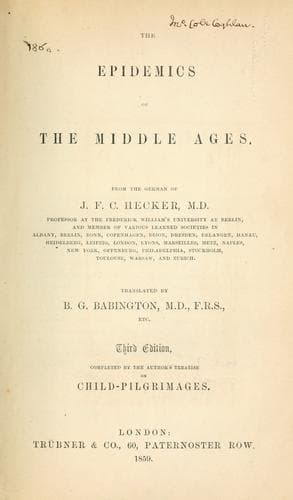
The Epidemics of the Middle AgesHecker, J. F. C. (Justus Friedrich Carl)
History
The Epidemics of the Middle Ages
Hecker, J. F. C. (Justus Friedrich Carl)
Black Death; Epidemics -- History; Hysteria, Epidemic
and thus indicated the reception of the poison. These streaked spots
were called, by an apt comparison, _the girdle_, and this appearance
was justly considered extremely dangerous[33].
CHAPTER III.
CAUSES.—SPREAD.
An inquiry into the causes of the Black Death, will not be without
important results in the study of the plagues which have visited
the world, although it cannot advance beyond generalization without
entering upon a field hitherto uncultivated, and, to this hour,
entirely unknown. Mighty revolutions in the organism of the earth, of
which we have credible information, had preceded it. From China to the
Atlantic, the foundations of the earth were shaken,—throughout Asia and
Europe the atmosphere was in commotion, and endangered, by its baneful
influence, both vegetable and animal life.
The series of these great events began in the year 1333, fifteen years
before the plague broke out in Europe: they first appeared in China.
Here a parching drought, accompanied by famine, commenced in the tract
of country watered by the rivers Kiang and Hoai. This was followed
by such violent torrents of rain, in and about Kingsai, at that time
the capital of the empire, that, according to tradition, more than
400,000 people perished in the floods. Finally the mountain Tsincheou
fell in, and vast clefts were formed in the earth. In the succeeding
year (1334), passing over fabulous traditions, the neighbourhood of
Canton was visited by inundations; whilst in Tche, after an unexampled
drought, a plague arose, which is said to have carried off about
5,000,000 of people. A few months afterwards an earthquake followed,
at and near Kingsai; and subsequent to the falling in of the mountains
of Ki-ming-chan, a lake was formed of more than a hundred leagues in
circumference, where, again, thousands found their grave. In Hou-kouang
and Ho-nan, a drought prevailed for five months; and innumerable swarms
of locusts destroyed the vegetation; while famine and pestilence, as
usual, followed in their train. Connected accounts of the condition
of Europe before this great catastrophe, are not to be expected from
the writers of the fourteenth century. It is remarkable, however,
that simultaneously with a drought and renewed floods in China, in
1336, many uncommon atmospheric phenomena, and in the winter, frequent
thunder storms, were observed in the north of France; and so early
as the eventful year of 1333, an eruption of Etna took place[34].
According to the Chinese annals, about 4,000,000 of people perished by
famine in the neighbourhood of Kiang in 1337: and deluges, swarms of
locusts, and an earthquake which lasted six days, caused incredible
devastation. In the same year, the first swarms of locusts appeared in
Franconia, which were succeeded in the following year by myriads of
these insects. In 1338, Kingsai was visited by an earthquake of ten
Public-domain text, read in full here on John Shaqi.
Reviews
Reviews
No reviews yet
Be the first to share your thoughts on this work.
Join the Discussion
Join the discussion
Sign in to leave a comment or review.
Sign InorCreate an account