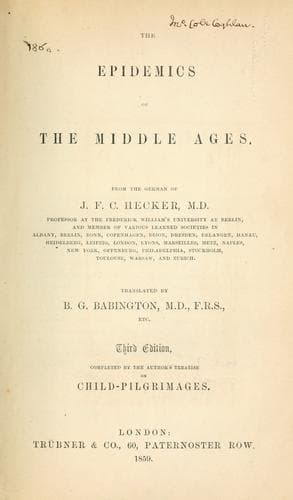
The Epidemics of the Middle AgesHecker, J. F. C. (Justus Friedrich Carl)
History
The Epidemics of the Middle Ages
Hecker, J. F. C. (Justus Friedrich Carl)
Black Death; Epidemics -- History; Hysteria, Epidemic
The dejection was increased by the universally active spirit of
persecution with which it was still hoped to eradicate the new
doctrine. Even whilst the English pestilence was raging, two
Protestants were burnt at Cologne[619]. In the same year faggots
blazed at Mecklin, Verden, and Paris, by the flames of which the
ancient faith was to be protected against the pestilence of freedom
of thought. Sentences of death were also quite commonly pronounced
against the Anabaptists in Protestant countries. The University of
Leipzig pronounced a condemnation of this sort in the year 1529, and
in Freistadt eleven women were drowned after a nominal trial and
sentence, because they acknowledged that they were of this sect[620].
Amidst these dissensions, and when the empire was in this helpless
condition, came the fear of the barbarians of the south, who had
already conquered Hungary under their Sultan Soliman, and, whilst the
English Sweat was raging in the countries of the Danube, threatened to
overwhelm Germany. It was a time of distress and lamentations, in which
even the most undaunted could scarcely sustain their courage[621];
but to the everlasting honour of the Germans it must be acknowledged
that they withstood this purifying fire with unsullied honour, and in
a manner worthy of themselves. For their noble spirits were aroused
to unheard-of exertions of energy, and whilst the pusillanimous gave
themselves up to despair, they impressed on the gigantic work of their
age the stamp of imperishable truth.
The siege of Vienna began on the 22d of September, after the English
pestilence had broken out in this capital of Austria, yet nobody
regarded this internal danger. The repeated attempts made by the
Turks to storm the town were repulsed with great courage, and, on
the 15th of October, Soliman raised the siege, after the Sweating
Sickness had raged with as much violence among his troops as among the
besieged[622]. There is no accurate intelligence extant upon this
subject, because the pestilence was less regarded here than elsewhere,
in consequence of the great distress of the country from other causes,
yet the mortality in Austria under such unfavourable circumstances, was
doubtless more considerable than in the neighbouring states[623].
Public-domain text, read in full here on John Shaqi.
Reviews
Reviews
No reviews yet
Be the first to share your thoughts on this work.
Elsewhere in the archive
Join the Discussion
Join the discussion
Sign in to leave a comment or review.
Sign InorCreate an account