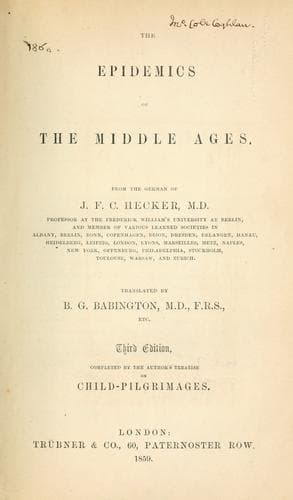
The Epidemics of the Middle AgesHecker, J. F. C. (Justus Friedrich Carl)
History
The Epidemics of the Middle Ages
Hecker, J. F. C. (Justus Friedrich Carl)
Black Death; Epidemics -- History; Hysteria, Epidemic
Yet after the first few days, in which many unfortunate cases occurred,
people became aware of the error they had committed. An advocate of the
twenty-four hours’ sudation, who, though not a medical man, had lauded
this practice in a pamphlet on the subject[634], died in Zwickau on the
5th of September, the victim of his own imprudence. A few days after
him died an apothecary, likewise treated with the heated bed. Upon
this the physicians immediately abandoned the practice, directed that
their patients should be sweated only for five or six hours, and in a
more moderate degree: and the estimable anonymous writer to whom we
have already alluded, thus seemed to meet with converts to his belief.
In Hamburgh also, men became convinced of the pernicious effects of
feather beds, and gave the preference to coverings of blankets[635];
for the English plan of treatment was presently known, and intelligent
philanthropists, who saw its curative powers, made it public[636] in
all quarters, through the medium of their correspondence. In Lübeck
there lived at the time of the Sweating Fever a learned Protestant
Englishman, Dr. Anthony Barns, who, with great kindness, made known
everywhere the English treatment of the disease. He was, however, after
the cessation of the pestilence, banished from the city, because he
had petitioned the bigoted Catholic senate to tolerate his Protestant
brethren. Many were saved by him; for it was the practice in this city
also, _to stew to death_[637] those affected with the disease. In
Stettin the English treatment was promulgated in good time, and two
travelling artisans who had come thither from Hamburgh, were of the
greatest assistance to the inhabitants of this city, by advising them
to take the feathers out of their upper beds; they made known likewise
how the sickness had been treated with success. They had seen cases
themselves, and could therefore distinguish by their odour those who
were suffering from the true sweating epidemic, from those who were
seized with fever arising from panic. They were constantly besieged by
persons asking questions and seeking assistance; and when the disease
was at its greatest height, the streets were quite illuminated at
night by the lights of the relatives of the patients[638], who were
running in all directions in a state of distraction. The abhorrence
of feather beds, and the hot plan, now followed so quickly the blind
recommendation of the twenty-four hours’ sweat, that by the middle
of September, and in many places still earlier, more correct views
were generally adopted, and some intelligent men, after the sad
experience which had been gained, seized the opportunity of doing more
good to the public than their noisy predecessors, who had by this
time so abundantly supplied the churchyards with bodies. Among these
literally and truly _beneficent_ physicians may be reckoned Peter
Wild, at Worms[639], who warned his countrymen against the Netherlands
Public-domain text, read in full here on John Shaqi.
Reviews
Reviews
No reviews yet
Be the first to share your thoughts on this work.
Elsewhere in the archive
Join the Discussion
Join the discussion
Sign in to leave a comment or review.
Sign InorCreate an account