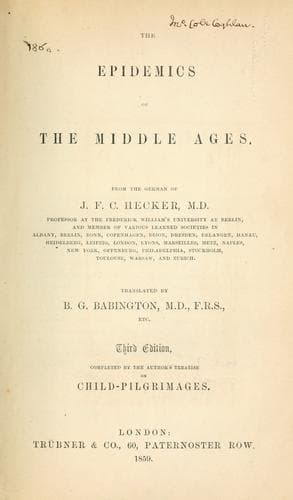
The Epidemics of the Middle AgesHecker, J. F. C. (Justus Friedrich Carl)
History
The Epidemics of the Middle Ages
Hecker, J. F. C. (Justus Friedrich Carl)
Black Death; Epidemics -- History; Hysteria, Epidemic
practice[640]; as also an anonymous person, (the names of the best
often remain unknown in times of confusion,) who, in popular language,
strenuously dissuaded the people against the use of feather beds[641].
It also soon became a common saying, ”the Sweating Sickness will bear
no medicine.”[642]
There is no ground for supposing that the influence of the faculty
was much greater in the country where the Sweating Sickness originated
than it was in Germany, for the number of learned physicians there was
still fewer, and the knowledge of medicine not nearly so extended as it
was in Italy, Germany, and France. The learned Linacre had already died
in the year 1524. John Chambre[643], Edward Wotton[644], and George
Owen[645], were the King’s body physicians about the time of the fourth
epidemic visitation of the Sweating Sickness. William Butts[646] of
whom Shakespeare[647] has made honourable mention, in all probability
likewise held a similar office. These were certainly distinguished and
worthy men[648], but posterity has gained nothing from them on the
subject of the English Sweating Sickness. All these physicians were
well informed, zealous, and doubtless also cautious followers of the
ancient Greek school of medicine, but their merits were of no advantage
to the people, who, when they departed from the dictates of their own
understanding, and did not content themselves with domestic remedies,
to which they had been accustomed, fell into the hands of a set of
surgeons so rude and ignorant that they could only exist in the state
of society which then prevailed[649].
SECT. 11.—PAMPHLETS.
Inexplicable as the silence of the learned physicians of England, on
the Sweating Sickness, appears at first view, (for where is the use
of learning if it fail to throw any light on the stormy phenomena
of life?) we may yet find, perhaps, its cause in a perfectly simple
external circumstance. The reformation had not yet begun in England,
the Catholic Church still stood on its ancient foundations, and an
intellectual intercourse between the learned and the people was not
by any means among the acknowledged desiderata. The faculty would
hence have been able to treat of the new disorder only in ponderous
Latin works, for they wrote unwillingly in their own language, and the
subject could not seem to them an appropriate one for this purpose,
because they found it unnoticed and uninvestigated by their highly
revered masters the Greeks. They were ignorant that a sweating fever
had ever appeared among the ancients, which, otherwise, might have
incited them to make researches of their own on the subject; for
Aurelian, who describes it to the life, was either unknown to them, or,
what at that time was a valid ground, was despised by them, on account
of his bad (unclassical) language.
Public-domain text, read in full here on John Shaqi.
Reviews
Reviews
No reviews yet
Be the first to share your thoughts on this work.
Elsewhere in the archive
Join the Discussion
Join the discussion
Sign in to leave a comment or review.
Sign InorCreate an account