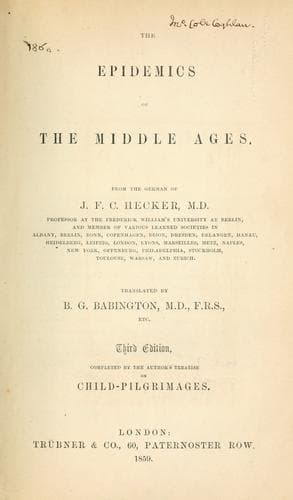
The Epidemics of the Middle AgesHecker, J. F. C. (Justus Friedrich Carl)
History
The Epidemics of the Middle Ages
Hecker, J. F. C. (Justus Friedrich Carl)
Black Death; Epidemics -- History; Hysteria, Epidemic
In Germany, on the contrary, the intellectual wants of the people
and of the educated classes had already manifested themselves very
differently. Twelve years before, the age of pamphlets had there
commenced. The thoughts of Luther and of his disciples, as also of
his opposers were winged by the rapid press, and the people took an
impassioned part in the endeavours of the learned to affect their
conviction, and by this altogether novel and authoritative mode of
religious instruction, became gradually educated and guided. Hence
it is not to be wondered at that people began to investigate, in
pamphlets, other important subjects likewise, and thus we see this
weighty branch of intellectual commerce, with all its advantages and
defects, also turned towards the discussion of popular diseases, and
for the first time unfolding its numerous leaves on the subject of the
English epidemic. In the maritime cities nothing of this kind happened,
because the eruption of the pestilence took them by surprise, and as it
was over again in the course of a few weeks, it seemed no longer worth
while to instruct the people respecting it.
This surprise was very plainly shewn in the answer of the doctors and
licentiates who were assembled together at the bedside of the Duchess,
at Stettin: “the disease was new and unknown to them: they were at a
loss what to advise, excepting strengthening medicines.”[650] In the
central parts of Germany, on the contrary, where, as early as the
month of August, the report of the new plague had excited the utmost
alarm, and where an eruption of the pestilence in Zwickau had caused
a general flight, publications on the Sweating Sickness were even
within that month, and still more numerously in September, disseminated
in all directions. As scientific productions, they are almost all
of them worthless. Many of them, indeed, did harm, and but very few
promulgated correct views. Most of them are now lost, as, for example,
that which was published by the printer Frantz, at Zwickau, on the 3rd
of September: but in what vast numbers they were published appears
from the circumstance that Dr. Bayer, at Leipzig, who brought out his
own on the 4th of September, states that he has read many of them, and
expresses his indignation against these “new unfounded little books,”
by which the people were misled to their own sorrow and suffering[651].
This same Dr. Bayer writes in the style of an intelligent practical
physician, inveighs boldly against the prejudices of mankind, and
the ignorance of medical _journeymen_, and against their senseless
bleedings whenever they see the barber’s basin and his pole. Some of
his advice too is not bad, especially where he is speaking of the
Arabian use of harmless syrups. He, however, religiously preserves
all the rubbish of his age, and has a great opinion of preventive
bleedings, purgatives, and powerful medicines, of which he prescribes
so many that his reader is necessarily confused by their multiplicity.
Public-domain text, read in full here on John Shaqi.
Reviews
Reviews
No reviews yet
Be the first to share your thoughts on this work.
Elsewhere in the archive
Join the Discussion
Join the discussion
Sign in to leave a comment or review.
Sign InorCreate an account