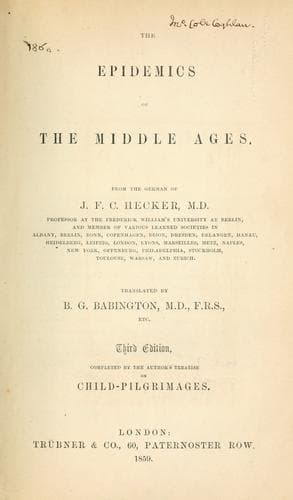
The Epidemics of the Middle AgesHecker, J. F. C. (Justus Friedrich Carl)
History
The Epidemics of the Middle Ages
Hecker, J. F. C. (Justus Friedrich Carl)
Black Death; Epidemics -- History; Hysteria, Epidemic
His precepts respecting the sweat are very appropriate, for he gives
a caution against forcing perspiration, prescribes according to the
circumstances, and even commences the treatment with an emetic, if the
state of the stomach seems to indicate its employment. In order to
guard against contagion, he recommends, at the approaching autumnal
fair, that foreigners from “_dying lands_” _should be accommodated in
distinct inns_, that fumigation should be carefully employed, and that
before each booth at the fair a fire should be kept up.
Another pamphlet by Caspar Kegeler, of Leipzig, is a melancholy
monument of the credulity which, from Herophilus to the present day,
has pervaded the whole medical art. It is a regular pharmacopœia for
the Sweating Sickness, thrown together at a venture, without any
insight into the nature of the disease. A mine of wonderful pills
and electuaries composed of numberless ingredients wherewith this
“mysterious worthy” undertakes to raise a commotion in the bodies of
his patients. If he had but seen even a single case of the disease he
would at least have known how impossible it would be to administer,
within the space of four-and-twenty hours, the hundredth part of his
pills and draughts. With what approbation this little pharmacopœia
was received by physicians of equal penetration and understanding as
himself, is shewn by the eight editions which it passed through[652],
and the melancholy reflection is therefore forced upon us, that
possibly thousands of sick persons were maltreated and sacrificed from
the employment of Kegeler’s medicines.
A third physician at Leipzig, Dr. John Hellwetter, states in his
pamphlet, that he has become acquainted with the Sweating Fever in
foreign countries, and on the subject of perspiration gives some very
good advice, evidently the result of his own experience, which reminds
us of the original English mode of treatment. His notion that fish
is injurious seems to have originated in the fact that the continued
employment of fish as an article of diet gives rise to offensive
perspirations, and his admonition to his medical brethren not to flee
from the sick, but to visit them sedulously and give them consolation,
furnishes ground for supposing that some of them had been pusillanimous
and dishonourable enough to withdraw themselves or to refuse their
assistance to the poor.
Public-domain text, read in full here on John Shaqi.
Reviews
Reviews
No reviews yet
Be the first to share your thoughts on this work.
Elsewhere in the archive
Join the Discussion
Join the discussion
Sign in to leave a comment or review.
Sign InorCreate an account