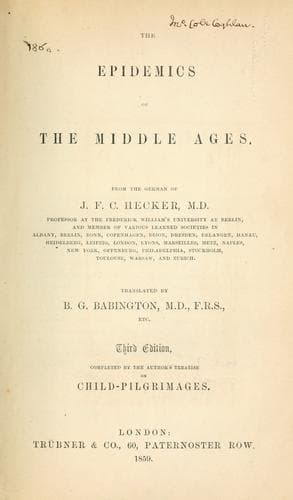
The Epidemics of the Middle AgesHecker, J. F. C. (Justus Friedrich Carl)
History
The Epidemics of the Middle Ages
Hecker, J. F. C. (Justus Friedrich Carl)
Black Death; Epidemics -- History; Hysteria, Epidemic
This is proved by a pamphlet, written in popular language, by a
physician in Wittenberg[654], which contains such correct medical
views, that our highest approbation is, even now, justly due to its
unknown author, as shewing, throughout, great judgment and a very
competent knowledge of the Sweating Fever. His whole treatment is
mild and cautious; he forbids the use of feather beds, but strongly
inculcates the necessity of avoiding every kind of chill, and therefore
recommends a practice in use at that time, called, “_the sewing of
the sick_,” that is to say, fastening the edge of the bed clothes to
the bed with a needle and thread. He orders his patients a moderate
quantity of warm but not heating beverage[655], refreshes them with
syrup of roses, and impresses upon his readers that the majority of
those affected will recover without medicine. In order to guard against
the stupor which was so exceedingly fatal, in addition to continual
conversation, refreshing odours of rose water and aromatic vinegar were
held before the patient’s nose, in a moderately damp cloth, or their
temples were cautiously bathed with them. Convalescents were watched
with great care, and it is not the least excellence of this very
sterling pamphlet that it likewise combated the timidity of the sick
with the inculcation of mild, but manly, religious principles, such as
corresponded with the spirit of that age. The rules here laid down are,
in essentials, the original English precepts which had already broken
the force of the epidemic Sweating Sickness in the year 1485, and the
author does not conceal his having in this matter received information
from Hamburgh, so far back as the 7th of August. That by this mode of
treatment not only individual patients[656] were saved, but also that
whole cities were protected against any very great mortality, we are
willing with the author to believe, and on this account we cannot but
lament the more, that the medical science of the rigid schools of those
days so completely mistook its office as the guardian of life, and
that it caused greater sacrifices by its hazardous remedies than the
pestilence would otherwise have occasioned.
Public-domain text, read in full here on John Shaqi.
Reviews
Reviews
No reviews yet
Be the first to share your thoughts on this work.
Elsewhere in the archive
Join the Discussion
Join the discussion
Sign in to leave a comment or review.
Sign InorCreate an account