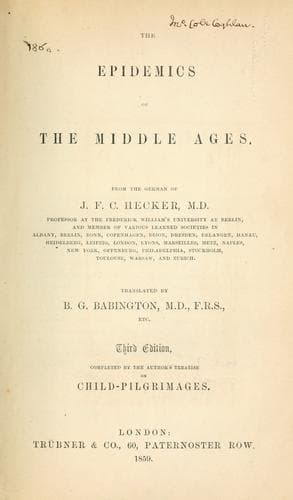
The Epidemics of the Middle AgesHecker, J. F. C. (Justus Friedrich Carl)
History
The Epidemics of the Middle Ages
Hecker, J. F. C. (Justus Friedrich Carl)
Black Death; Epidemics -- History; Hysteria, Epidemic
How soon the English treatment met with the recognition which it
deserved may be gathered from a Latin composition nearly of the same
tenour as the above, and which appears to be an extract from some
German pamphlets[657]. Besides aromatic odoriferous waters, the
very harmless and only remedies therein recommended are pearls and
corals given internally by tablespoonfuls in warm rose water. As a
prophylactic, treacle, which was in very common use, was recommended to
be taken in the juice of roasted onions, but only in very small doses.
Similar just views with respect to the excitement of perspiration were
also subscribed to by other physicians[658], and finally the great
council at Berne, on the 18th of December, published an exhortation to
patience and unshaken courage, in which the use of feather beds, and
of all medicines, except cinnamon water, was earnestly deprecated[659]
during the disease. The court of Holland also recommended a method
of cure[660] apparently English, these two documents being the only
traces, on the part of any governments, of a paternal solicitude for
their subjects.
The learned and accomplished _Euricius Cordus_[661], of Marburg, had,
when he wrote[662], no information respecting the successful English
mode of treatment, and, with all his celebrity, only followed in the
ranks of ordinary advisers. He could not free himself from the medical
precepts which he brought from Italy and gave to the only patient
at Marburg, who was the subject of the Sweating Sickness, the very
disagreeable, though much employed potion of “Benedetto.”[663] His
prophylactic ordinances were very burthensome, though with respect
to the frequent employment of purgatives, which at that time almost
all physicians recommended, it must be taken into account, that the
intemperance so prevalent in those days, rendered them in general more
necessary, perhaps, than they are at the present time. Bishop Ditmar of
Merseburg, has betrayed to posterity, that this celebrated man had a
great dread of the new disorder, and did not conceal his anxiety[664].
There is still extant a very complicated prescription of _Achilles
Gasser_[665], the learned physician of Augsburg, which he employed
with childish confidence[666] during the prevalence of the sweating
pestilence. We might class this with a thousand others of a similar
character, were it not evident how little medical art, at that time in
its ancient Greek garb, was suited to the exigency of the age, being
dull, inefficient, and long since robbed of its original spirit; for
thus alone was it taught in the universities.
Public-domain text, read in full here on John Shaqi.
Reviews
Reviews
No reviews yet
Be the first to share your thoughts on this work.
Elsewhere in the archive
Join the Discussion
Join the discussion
Sign in to leave a comment or review.
Sign InorCreate an account