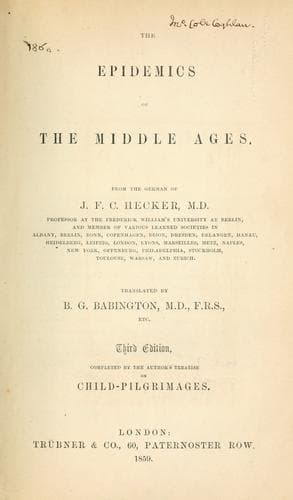
The Epidemics of the Middle AgesHecker, J. F. C. (Justus Friedrich Carl)
History
The Epidemics of the Middle Ages
Hecker, J. F. C. (Justus Friedrich Carl)
Black Death; Epidemics -- History; Hysteria, Epidemic
This plainly appears from the pamphlet of a physician in great practice
at Ghent, Tertius Damianus, from Vissenaecken, near Tirlemont[672],
whose own wife fell sick of the sweating fever, and fortunately was
again restored[673]. The cases whereof Damianus gives an account,
are among the most marked of which any mention is made, and it also
seems, that the disease, contrary to the opinion of many, arose from
fear alone, and manifested in the Netherlands a much greater power
of contagion than in Germany, to which the hot treatment may have
contributed[674]. The manner in which Damianus restrained his patients
from indulging in their propensity to sleep, is worthy of notice. When
the usual means failed, he directed that their hair should be torn
out, that their limbs should be tied together in painful positions,
and that vinegar should be dropped into their eyes[675]: the danger
justified these means, but violence does not easily attain its end. For
the rest, the views of this physician do not differ from those commonly
entertained, and if he complains[676] of the great extortions of the
apothecaries, this was a natural effect of the customary prescriptions,
whereof he himself recommends many that are very objectionable.
Whatever the science of medicine of the sixteenth century could oppose
to so fearful an enemy, is set forth in the very excellent treatise of
_Joachim Schiller_[677] of Freiburg, which, however, did not appear
until two years later, and unfortunately does not give the wished-for
information on the development of the pestilence in the Briesgau.
Schiller is moderate in his views, and shews throughout, that he is a
very well informed physician, and well versed in Greek literature: and
although he cannot steer clear of the rubbish of clumsy remedies, yet
the fault should not be charged on him, but on the age in which he
lived. This, like every other, had its evils, and enveloped in clouds
and darkness the genius of medicine, which, free, great, and elevated
above human short-sightedness, is respected only by the intellectual
servants of nature.
SECT. 12.—FORM OF THE DISEASE.
The notions of contemporary writers respecting the phenomena and
the course of the sweating epidemic are, it is true, individually
unsatisfactory and defective[678]; yet collectively, we may gather from
them a lively and complete picture of its effect on the human frame;
especially from the German observers, who reported truly and honestly
their own, as well as the general experience of their age; for the
English had up to that period described little more than the external
appearances of this epidemic, which had already attacked them for the
fourth time.
Public-domain text, read in full here on John Shaqi.
Reviews
Reviews
No reviews yet
Be the first to share your thoughts on this work.
Elsewhere in the archive
Join the Discussion
Join the discussion
Sign in to leave a comment or review.
Sign InorCreate an account